Profile
David and Sybil Yurman: A Life in Art, Made Wearable
Hannah R. Harris / Nov 20, 2025

Christie's record-breaking Geneva sale of the Ocean Dream diamond, set against a near-contemporaneous no-sale for another exceptional blue diamond, reveals a collector market that is vigorous but intensely selective.
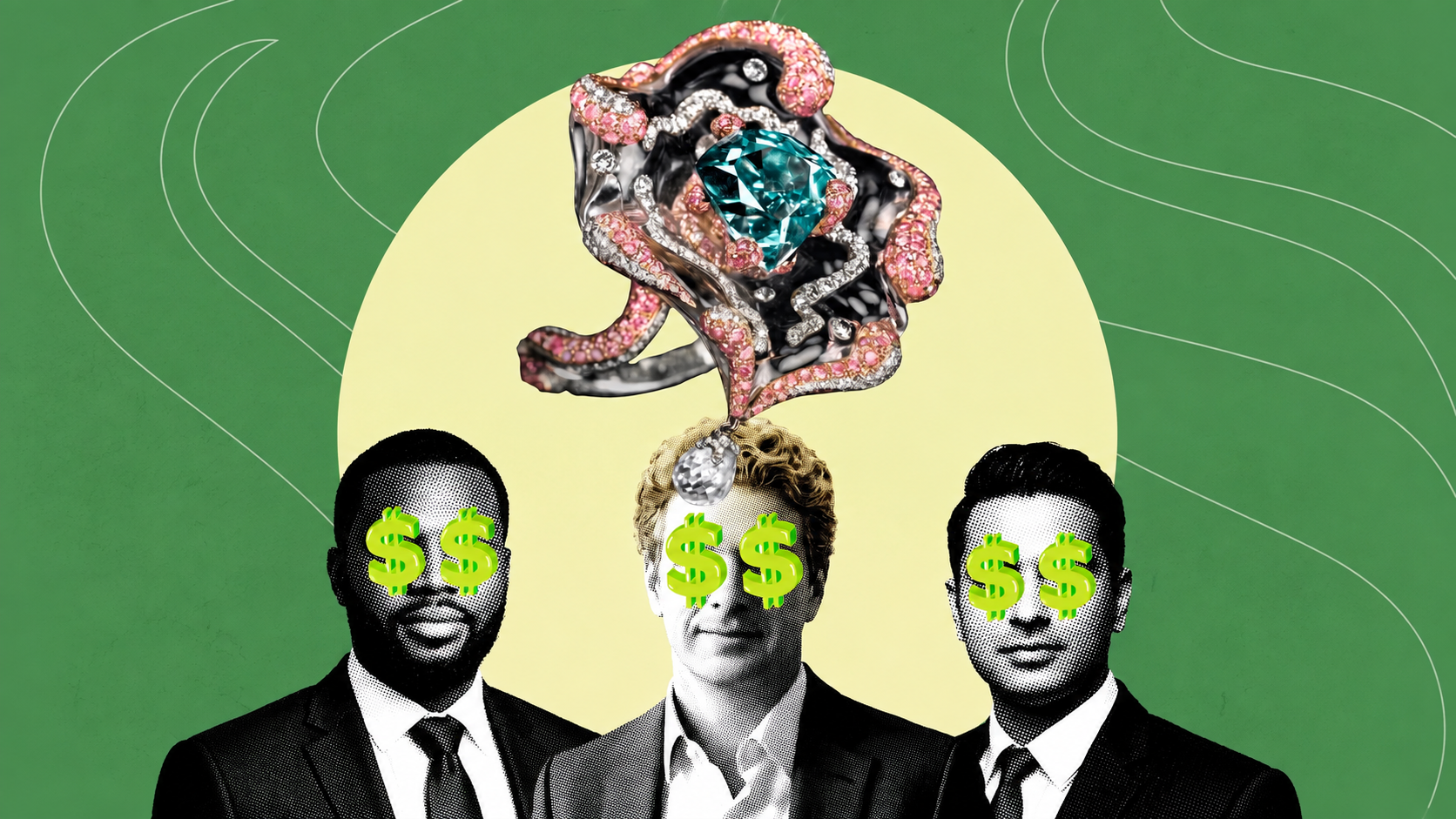
Christie's record-breaking sale of the 5.50-carat Ocean Dream in Geneva was more than a headline result for a very rare blue-green diamond. Set beside a near-contemporaneous failure for another exceptional blue diamond across town, it offers a sharp view of a collector market that is both vigorous and intensely selective.
At Christie's Geneva on May 13, the final lot held the room for 20 minutes. The Ocean Dream, a 5.50-carat triangular-cut Fancy Vivid blue-green diamond, sold for CHF 13,567,500 (US$17,366,400), the auction house said, making it the most expensive Fancy Vivid blue-green diamond sold at auction. It was also the highest-priced lot of Geneva Luxury Week. Christie's reported that the sale's total reached CHF 51.86 million, with 99% of lots sold.
The price tells only part of the story. The stone had already acquired a public identity: it was found in Central Africa in the 1990s and appeared in the Smithsonian's Splendor of Diamonds exhibition in 2003. It had previously sold at Christie's in 2014 for about $8.5 million, according to Associated Press reporting. In other words, it arrived with a name, exhibition history, prior auction comparability and a color description that is immediately intelligible even to a collector who is not a gemologist.
The competitive drama was real rather than merely promotional. Christie's said that three international collectors pursued the final lot, while the sale attracted bidders from 40 countries; 41% of participants were from Europe, 28% from Asia-Pacific and 27% from the Americas. Thirteen lots cleared $1 million, including a 22.28-carat, no-heat Kashmir sapphire by Chaumet at CHF 2.744 million and a two-row natural-pearl-and-diamond necklace at CHF 4.147 million. Those results matter because they show that Ocean Dream was not a solitary bolt of lightning: buyers were willing to compete across colored stones, pearls, historic design and signed jewelry.
The day before Ocean Dream's triumph, Sotheby's offered a different sort of rarity: an internally flawless 6.03-carat Fancy Vivid blue diamond recovered from South Africa's Cullinan mine. It was estimated at $9.2 million to $12.3 million and did not sell. National Jeweler's contemporaneous report says Sotheby's later stated that it was speaking with interested parties, and that the sale nonetheless achieved $30.1 million with 93% of lots sold.
That is not evidence that blue diamonds suddenly lost their appeal. The Sotheby's sale had more than five registered paddles, on average, for every lot sold, and more than 60% of sold lots beat their high estimates. Its top lot was instead a matched pair of 18.38-carat Type IIa, D-color diamonds from Botswana's Jwaneng mine, which brought $3.3 million. The same report notes strong prices for an emerald necklace, an unmounted 102.40-carat sapphire, a pink-diamond ring and signed jewels.
Nor is a single pass a verdict on the unsold diamond. A private transaction could still occur, and an auction-room no-sale can reflect the relationship between reserve, estimate, timing and the handful of clients prepared to bid, not an objective appraisal of beauty. Sotheby's explicitly said it remained confident the stone would find a home. Still, the juxtaposition is unusually instructive: two elite blue-family diamonds were offered in the same city in the same week; one became a record, while the other did not cross the line in public.
Analysis: The Ocean Dream result suggests that, at the top end, rarity is now an entry ticket rather than a conclusion. The winning lot combined several forms of scarcity: an unusual blue-green hue, a marketable name, a distinctive triangular form, a known public history and a prior auction result against which collectors could measure its return. That combination makes a jewel legible as a cultural object, not simply as a specimen.
The Cullinan diamond had persuasive credentials of its own, exceptional color, internal flawlessness and a famous source, but its pass illustrates the limits of treating a grading report as a guarantee of auction momentum. A buyer can admire a stone and still wait for price alignment, a more congenial sale format or a stronger reason to own this example now. The most sophisticated collector is not choosing between beauty and financial discipline; they are exercising both at once.
This is also why provenance is broadening beyond the familiar shorthand of royal ownership or celebrity wear. Ocean Dream's Smithsonian appearance and auction history supplied something equally valuable: an independently visible biography. Meanwhile, Christie's Geneva sale found buyers for a Cartier Art Deco tiara, a 1925 Cartier sautoir worn in the 1974 film The Great Gatsby, and a Boucheron necklace made for the 1925 Paris decorative-arts exposition. Christie's results make clear that museum-quality design, cinematic association and historic context can create demand alongside carat weight.
For jewellers and estates considering the secondary market, the practical implication is not that every jewel requires a celebrity backstory. It is that documentation is part of the asset. Original maker records, period photographs, exhibition catalogues, gem reports, restoration history and a defensible ownership trail do more than support a catalogue entry. They reduce uncertainty and give a specialist a coherent case to make to a global audience.
The season's wider figures support the view that collectors are active. Citing ArtTactic's half-year review, Observer reported that jewelry was the largest luxury-auction category in the first half of 2026, generating $454.9 million, up 8.3% year on year. Online jewelry sales accounted for 19.3% of value but 59.3% of volume, a useful reminder that the collector funnel increasingly begins digitally even when the most expensive stones conclude by telephone.
There is an important qualifier. The same report says the three leading houses' overall first-half auction growth was heavily concentrated at the top, with single-owner collections accounting for 32% of sales value. That does not diminish the appeal of Ocean Dream; it contextualizes it. Trophy results can coexist with a market in which ordinary quality, weak presentation or unrealistic reserves struggle for attention.
Ocean Dream did not simply sell for a lot of money. It converted a narrowly defined gemological rarity into shared conviction among three bidders, then into a public benchmark. That is the hard part of the high-jewelry secondary market: creating the conditions in which a collector believes an object is both singular and correctly priced.
The lesson from Geneva is therefore more nuanced than colored diamonds are hot. Exceptional colored diamonds are attracting serious capital, but the premium is being awarded selectively, to jewels that unite rarity with narrative, quality with documentation, and spectacle with confidence. In a market increasingly filled with data, the most powerful luxury object may still be the one whose story makes the data feel inevitable.