Profile
David and Sybil Yurman: A Life in Art, Made Wearable
Hannah R. Harris / Nov 20, 2025

As lab-grown wholesale prices keep falling and export value shifts toward finished jewelry, independent founders face a narrowing set of defensible positions to build a business around.
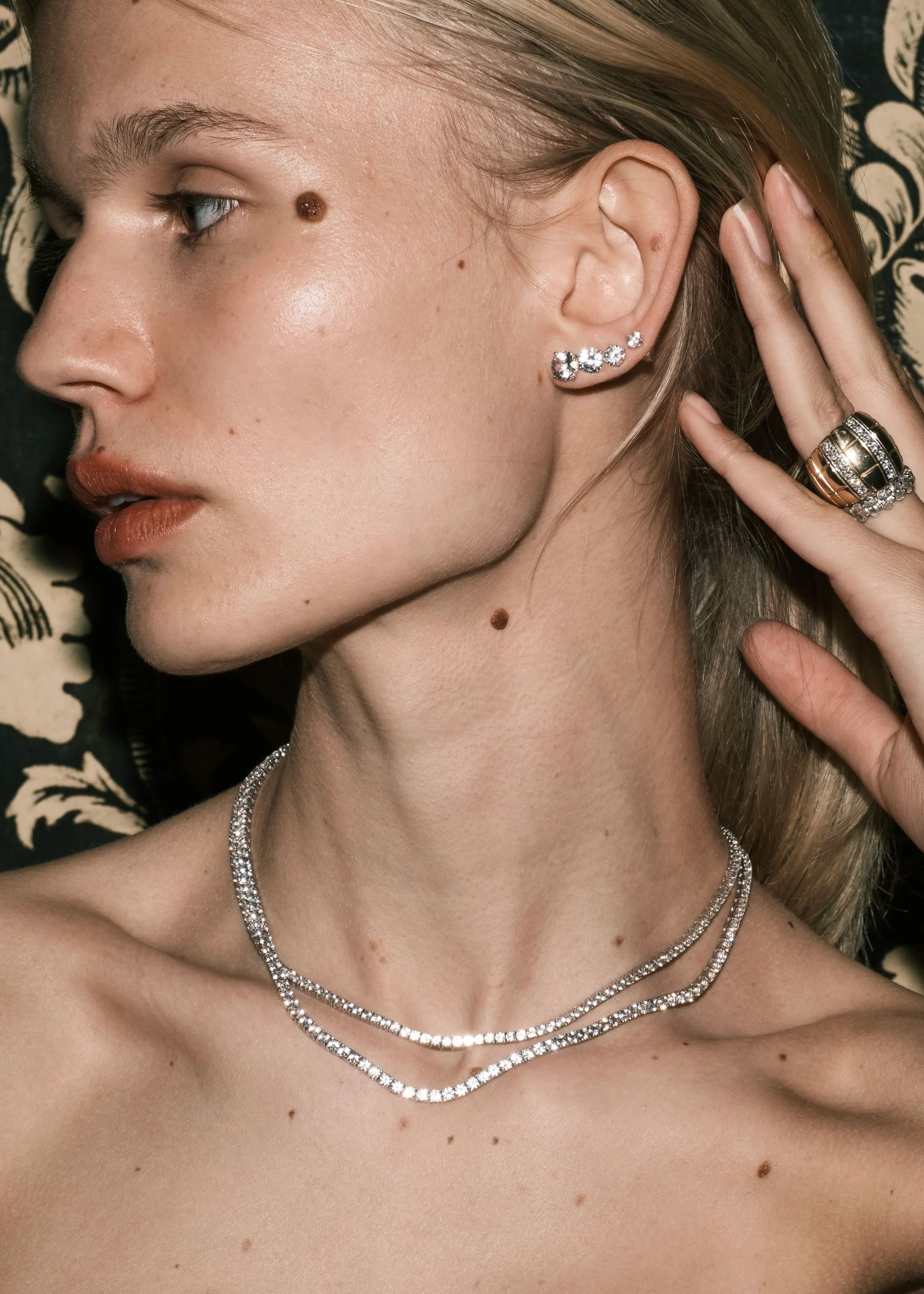
In April 2026, the Gem and Jewellery Export Promotion Council closed the books on India's FY2025-26 diamond trade, and two numbers sitting next to each other told the real story. Polished lab-grown diamond exports fell 10.55 percent in dollar value even as the volume of stones leaving the country rose. In the same release, exports of lab-grown-studded gold jewelry, finished pieces, not loose stones, rose 31.30 percent. The stone lost value. The object did not.
The input side confirms it. Thailand's Gem and Jewelry Institute recorded lab-grown wholesale prices down 13 percent year over year in its Q2 2026 list, and India's rough lab-grown imports, the raw material entering the pipeline, fell 26.59 percent by value across FY2024-25. Together, these describe one event: the loose stone has become a commodity, priced like one. For a founder who built margin around that stone as the asset, this is not a market update, it is an instruction to redesign the business.
The most common mistake is treating lab-grown buyers as a single price-sensitive segment, and the consumer research does not support it. The Plumb Club's 2025 survey found 74 percent of respondents open to giving or receiving a lab-grown engagement ring, and 83 percent open to non-bridal lab-grown pieces, far beyond the bridal conversation most brands are still having. The Knot's 2025 study found 52 percent of couples reported a lab-grown stone in their engagement ring, with average spend of $4,900 against $7,600 for a mined-diamond ring, and a larger average carat weight at the lower price point. That is not one customer choosing to spend less. It is at least four customers with different reasons for the same purchase: one reallocating budget toward size or metal, one chasing a silhouette she could not otherwise afford, one asking pointed questions about origin and labor first, and one who wants natural stone for its rarity and is not moved by price at all.
Awareness is no longer the constraint. The Plumb Club reported in April 2026 that 84 percent of consumers already knew a choice existed between lab-grown and natural diamonds, and 65 percent said they would consider lab-grown for fashion jewelry beyond bridal. The founder's job has shifted from educating the market to interpreting it: assortment, photography, and sales scripts built around motive, not price point.
Against that segmentation, four defensible positions carry four different cost structures. A brand can own accessible modern bridal: a tightly edited menu of proven shapes, transparent pricing, and fast, informed service, competing on ease rather than a scarcity claim it cannot support. It can own design abundance: using lower stone cost to make scale, clusters, and unusual silhouettes reachable, leading with the piece, not the laboratory process behind it. It can own verified premium: charging more, but making that premium visible in cut selection, bespoke setting work, a documented supplier standard, and lifetime care, not in an old assumption about the stone's lasting value. Or it can position as an impartial two-category advisor, carrying both natural and lab-grown stones under one comparison script, letting the customer's budget, symbolism, and risk tolerance decide. That fourth path has the highest trust ceiling and the hardest operations.
Disclosure sits underneath all four positions, and it just became harder to execute. The FTC requires that "cultured" be clearly qualified as laboratory-grown or not mined, on the product page, in the cart, on the invoice, and in the appraisal. But the labs writing those reports no longer agree on how to grade the stone. GIA moved its D-to-Z lab-grown assessments off the color-and-clarity nomenclature it built for natural diamonds in October 2025, replacing it with descriptive "Premium" and "Standard" terminology. IGI reaffirmed in July 2025 that it would keep using the 4Cs for both categories. That means reports from the two labs no longer say the same thing, and a sales floor trained on one script will misstate the other.
The near-term work is specific. Reprice the top twenty lab-grown SKUs from today's replacement cost, and decide deliberately whether the savings go to the customer, back into setting and service, or into margin. Reduce owned loose-stone breadth and reserve inventory for hero pieces that earn their photography, using memo sourcing or short reorder cycles for everything else, since it is a wasting asset while prices fall. Audit every product page, ad, script, and invoice for where "laboratory-grown" actually appears, not implied. I expect the brands that make these calls in the next two quarters to be the ones still setting price in this category by 2027, rather than reacting to whoever sets it for them.