Profile
Rachel Scott on Craft, Context, and the Expansive Language of Diotima
Hannah R. Harris / Aug 8, 2026

Chicago artist and designer Hai-Wen Lin brings fashion, sculpture and kitemaking into the 2025 Burke Prize installation at New York's Museum of Arts and Design through October 11.
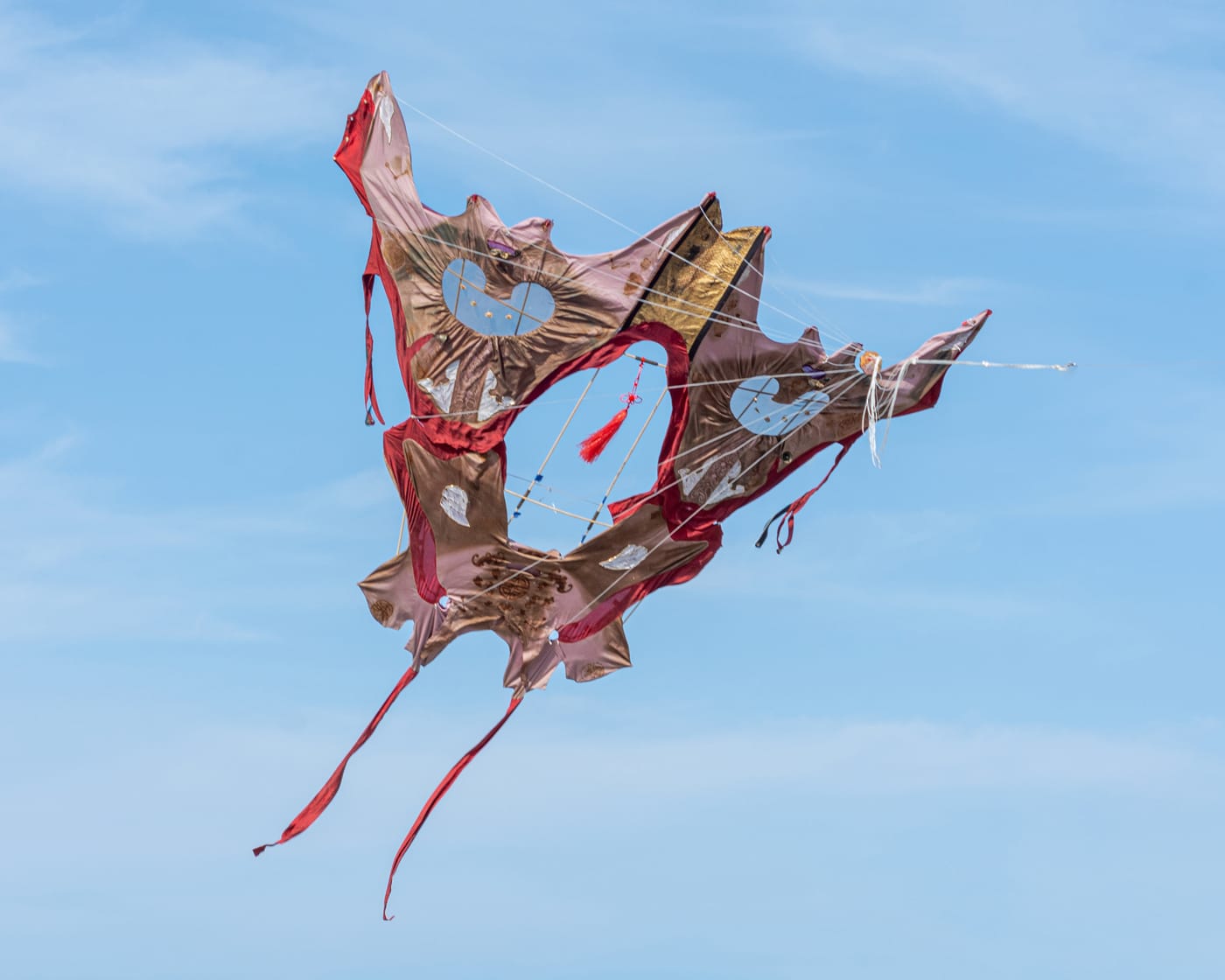
Hai-Wen Lin's kites are built the way garments are built: cut, dyed, sewn, dressed with beads and feathers, fitted to a body. Then the artist lets them go. The pieces on view in the 2025 Burke Prize installation at the Museum of Arts and Design, in the Jerome and Simona Chazen Building on Columbus Circle, New York, through October 11, 2026, are equally kite and clothing, engineered to fly and cut to wear. Lin, who is based in Chicago and uses they/them pronouns, has described the practice as "an act of reorienting: looking back, looking forward, looking in, looking up."
The Burke Prize is a $50,000 unrestricted award the museum has given annually since 2018 to a United States-based artist under 45 working in traditional craft materials with what the museum calls conceptual rigor and a mastery of process. The four other 2025 finalists were Sula Bermudez-Silverman, Chenlu Hou, Raul De Lara and Abigail Lucien. Lin's win recognizes a body of work built from sun-dyed and hand-dyed fabrics, indigo and turmeric, cyanotype printing, ceramic beads, feathers, rust dyes, silk, cotton, velvet, bamboo and jewelry chain: materials chosen as much for how they behave in wind and light as for how they read on a body.
The installation's central work, Send Them Their Flowers (2024), pairs kites roughly 53 by 40 inches, made of silk, bamboo, hand-woven tassels and jewelry chain: objects sized and shaped like garments but built to be handled by wind rather than a wearer alone. Lin's practice regularly documents that handoff directly. An earlier piece, made in Chicago's Wicker Park in October 2022, records an hour, 2:56 to 3:56 in the afternoon, of a kite-garment flown communally, the artist's title noting, almost as an aside, that the group probably should not have fed the sparrows the spectacle drew.
That willingness to hand control to the sky, or to a crowd, is the argument the whole installation makes about clothing. Lin has asked, of the work, "What does it mean to care for, drape, dress, and accommodate change and instability?" It is a fashion question posed with none of fashion's usual tools: no fitting room, no mirror, no single wearer whose body the garment is cut to flatter. A kite fails or succeeds in public, shaped by gravity, gust and whoever is holding the string, and Lin treats that loss of control as the more honest account of what clothing actually does once it leaves the design table: get pulled at, rained on, passed between hands, altered by conditions the maker cannot fully predict.
Elissa Auther, MAD's deputy director of curatorial affairs and the Burke Prize's chief curator, has overseen a prize that has increasingly rewarded work like Lin's: participatory, environmentally contingent, resistant to a single finished silhouette. That marks a shift from craft's older prize logic, which tended to reward mastery demonstrated in a static, perfectible object. Lin's kites are not more perfectible than a hand-set stone or a hand-finished seam. They are differently ambitious, judged by how well they perform once the maker's hand is no longer the only hand involved.
Fashion asks fit, silhouette, movement and authorship as though those questions end at the body's edge. Lin's kites carry the same questions outward, into the atmosphere a body normally moves through without noticing, and answer them by admitting that the most interesting part of a garment might be the part the designer cannot control at all.