Profile
David and Sybil Yurman: A Life in Art, Made Wearable
Hannah R. Harris / Nov 20, 2025

A summer exhibition of the Goldsmiths' Craft & Design Council Awards in Clerkenwell argues that jewellery's next chapter belongs to designers who unite handwork, technology, art and commerce rather than choose between them.
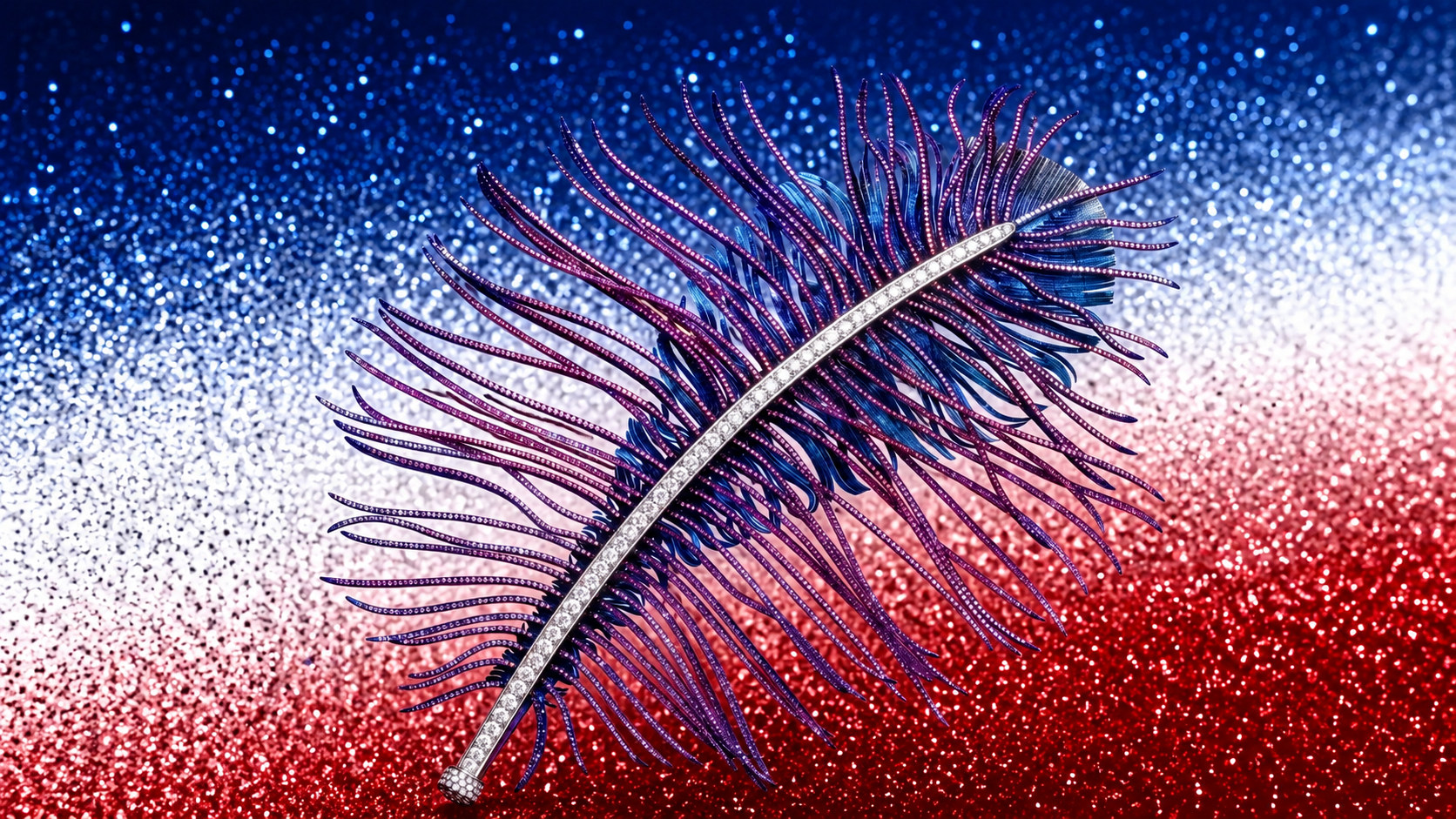
The title sounds almost weightless: Downy Feather Brooch. But the object at the centre of this summer's Goldsmiths' Craft & Design Council Awards Exhibition carries a much heavier proposition. Made by Janet Barber in titanium, mother-of-pearl and diamonds, it received the 2026 Goldsmiths' Company Award for Exceptional and Outstanding Design. The judges praised its technical combination and craftsmanship; the Goldsmiths' Centre says it left them spellbound.
That word is useful. It names the thing the jewellery business is actually trying to sell when metal prices, digital tools and fashion cycles all compete for attention: not simply materials, but a moment of surprise made durable.
The exhibition, open at the Goldsmiths' Centre in London from 2 July to 10 September, gathers a curated selection from this year's awards. It is free, and it is timely. The 2026 competition drew 837 entries across 46 categories and awarded 67 Gold Awards, according to the Centre. That scale makes the show more than a handsome display of prizes. It is a compact snapshot of the forces shaping British jewellery design: an appetite for unusual materials, a renewed insistence on demonstrable skill, and a growing recognition that a strong idea must survive the journey from bench to buyer.
It would be easy to read Barber's brooch as a familiar luxury formula, diamonds, iridescence, a natural-world motif. The more interesting reading is structural. Titanium brings lightness; mother-of-pearl introduces a changeable, almost atmospheric surface; diamonds provide pinpoint brilliance. The work is recognisably precious without letting gold carry the entire argument.
That choice matters culturally. For decades, fine jewellery has often communicated value through visual density: bigger stones, more carats, more immediately legible codes. A feather reverses the emphasis. It asks the wearer to notice edge, sheen, layering and apparent fragility. The preciousness is in the resolution as much as in the inventory.
This is analysis, not a claim that one brooch has inaugurated a movement. But the exhibition's wider roster supports the sense that material character is becoming a primary design language. Among the works named by the Centre are Caitlin Murphy's Alpha Box in niobium and rose gold, Dan Voaden's Candy Cane Coral ring with sea-green opals, and Seongmin Kim's carved-pearl Harmony necklace. Their common denominator is not a house style. It is a willingness to let colour, engineering and surface do some of the storytelling traditionally assigned to the gemstone alone.
The Council's own competition architecture makes that openness explicit. Its conceptual-jewellery category welcomes precious and non-precious materials in designs with an engaging story or concept; its brief calls for creative innovation and originality. The combined craft-and-design categories also include wire innovation, horn and polymers, and laser technology. Jewellery here is being treated as a field of techniques and ideas, not merely a hierarchy of materials.
Yet this is no manifesto for novelty at the expense of discipline. The exhibition's strongest signal may be its refusal to separate experimental design from exacting making.
Consider Annabel Hood's Florid Scrolls, the Junior Award winner: a hand-engraved steel piece with a silver-inlaid monogram, made during a gun-engraving apprenticeship. Or the Council's setter criteria, which specify the evenness of stone spacing and the precision of bright cuts. Its enamelling brief still names champlevé, cloisonné and plique-à-jour, techniques that demand concentrated manual control and a high tolerance for failure.
Such details can appear fussy from a distance. In fact, they explain why craft remains a commercial differentiator. A consumer may not have language for a back-hole, a clean solder joint or an even rub-over edge, but the eye reads coherence. The object sits differently. Light moves cleanly across it. A clasp works. The wearer senses care before they can identify its source.
That is why the current fascination with craft should not be mistaken for nostalgia. The point is not to preserve old methods behind glass. It is to keep a vocabulary of making alive so designers can choose it deliberately, alongside CAD, laser welding and new materials, rather than inherit a reduced menu of what is possible. The Council's laser category, for instance, asks entrants to explain whether technology was used for welding, cutting or engraving and judges whether it benefits the outcome. The standard is not technology for its own sake; it is appropriate technology.
Jewellery culture is often divided into clean camps: collectible art jewellery on one side, commercially viable fine jewellery on the other. The GC&DC structure makes that binary look increasingly unhelpful.
Its Fine Commercial Jewellery brief asks for contemporary, reproducible pieces in precious metals and gemstones, and explicitly weighs commercial awareness and potential alongside originality, construction and finish. The award's retailer partner, Beaverbrooks, may offer the winner exposure to product development, buying and marketing, and could explore manufacture. Meanwhile, the conceptual category permits one-off body adornment and evaluates narrative and innovation.
That proximity is revealing. A technically accomplished pendant with no emotional charge is unlikely to travel far in culture. A provocative brooch that cannot sit on a body, communicate its price or be photographed convincingly can struggle to build a living practice. The most resilient independent designers are increasingly expected to navigate both languages: make a persuasive object, then make its meaning, production logic and visual world legible to someone beyond the studio.
The Goldsmiths' Centre has put that reality into its newest talent programme as well. Its recently announced Shine 2026 cohort will receive training in photography, video, visual merchandising and collection storytelling before a public launch in September. Thirteen designer-makers have been selected, and their work will be exhibited and sold through 18 December. That is an unusually frank acknowledgement that a contemporary jewellery career is built at the intersection of bench skill, image-making, retail literacy and direct connection with an audience.
The Clerkenwell show should not be confused with a retail trend forecast. It is better than that: a picture of the conditions from which trends eventually emerge. Its work moves between titanium and pearl, opal and niobium, engraving and lasers, full-scale commercial propositions and singular objects. The range does not resolve into a single look, but it does point to a shared ambition, jewellery that carries a point of view without sacrificing the intelligence of its making.
For brands, buyers and young designers, that offers a more durable lesson than wear more colour or invest in brooches. In a category crowded with instant imagery, distinctiveness will come from decisions that reward close looking: an unexpected material pairing, a clasp solved beautifully, a surface that changes as a body moves. Those are not decorative extras. They are how a piece gains memory.
Barber's feather is therefore an apt emblem. It is a tiny subject, rendered with enough technical and material confidence to become an argument about scale: the most resonant future-facing jewellery may be the work that asks us to slow down and look nearer.