Profile
Rachel Scott on Craft, Context, and the Expansive Language of Diotima
Hannah R. Harris / Aug 8, 2026

British-Somali artist Fozia Ismail turns the endangered xeedho wedding basket into a living archive in A Song for the Xeedho, at Whitechapel Gallery through September 6.
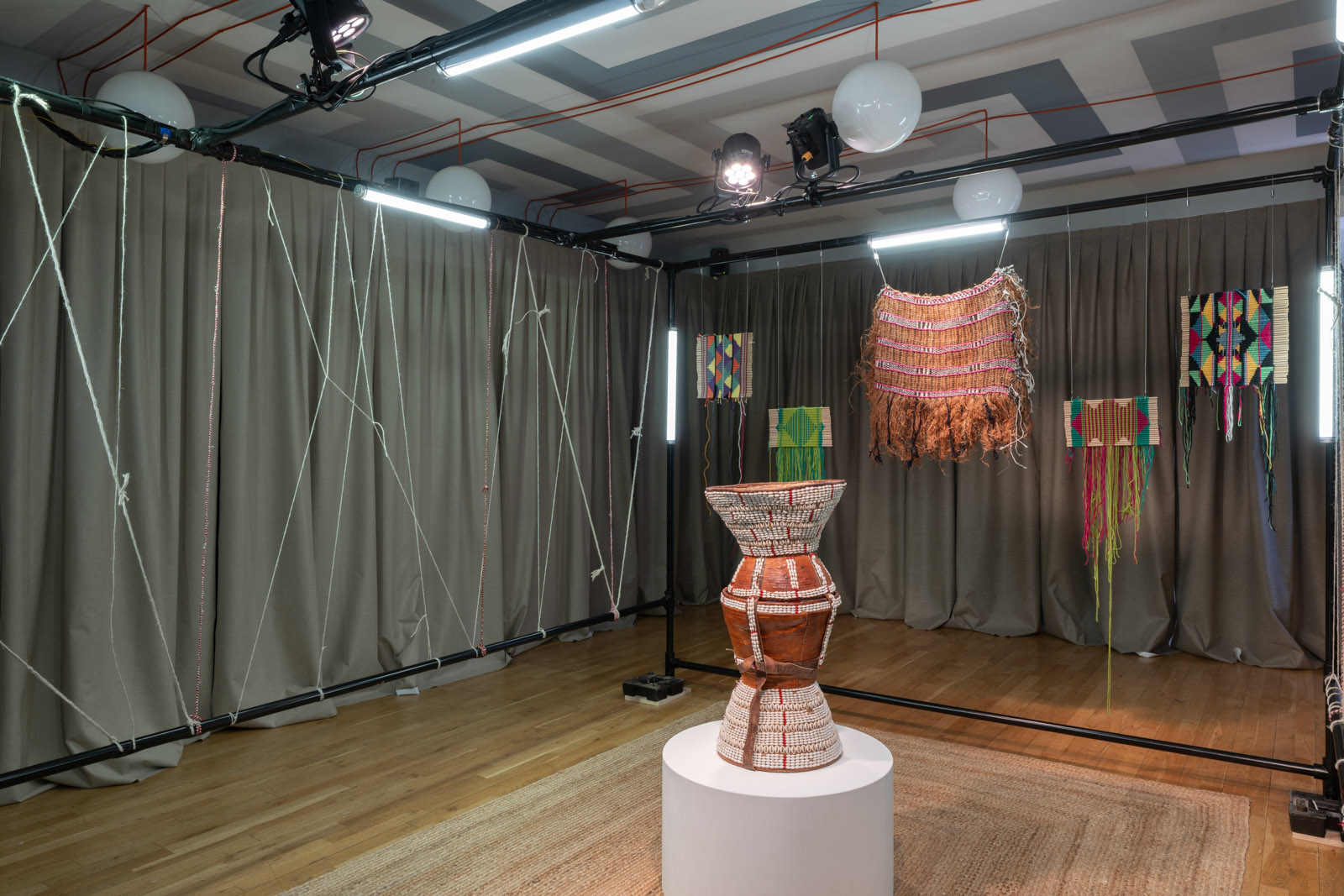
A xeedho is not one object but three actions bound into one: weaving, ropemaking and knot-work, performed collectively by Somali nomadic women to build a wedding vessel that must be untied, publicly, by the groom. Get the knot wrong and it resists. Get it right and the cloth falls open to reveal the gifts inside. That mechanics of tension and release is the subject of A Song for the Xeedho: The Knot Makers, Fozia Ismail's installation in the Mezzanine Studio at Whitechapel Gallery, London, on view July 15 through September 6, 2026, co-commissioned by Counterpoints Arts and Whitechapel Gallery.
Ismail works across food, sound, textiles and found objects. She founded Arawelo Eats and co-founded the dhaqan collective, and her practice returns often to Somali nomadic feminist pedagogy: the informal, oral, hand-to-hand systems by which women pass down survival knowledge. In her statement for the show, she traces the project to a single photograph of her mother in Somaliland in 1998, sitting with her sister and another woman against a bright blue wall, hands moving as they twist plant fibres into wedding rope. That image, rather than the finished basket, is the exhibition's real starting point: not the object, but the labour and transmission that made it.
The exhibition's public programme makes the argument explicit. On August 15, in the Clore Creative Studio, writer and archivist Ibrahim Hirsi, co-founder of Koor Archives, joined artist-researcher Heather Marks for Listening to the Xeedho Archive, a session built around the sound and research materials behind Ismail's work, including oral traditions and southern Somali poetic forms tied to the object. The programme closes on August 20 with a roundtable, moderated by Marks, featuring Orsod Malik, the Sudani curator and executive director of the Stuart Hall Foundation, addressing what the gallery frames as diasporic knowledge systems and anticolonial archiving practice.
That framing matters because the xeedho's endangerment is not a matter of taste falling out of fashion. It is tied to the climate crisis reshaping the pastoral life that produced its raw materials and the occasions for making it: plant fibre, rope, the gathering of women with time to work together. A craft object dependent on a particular ecology and a particular social structure does not survive by being admired. It survives by being transmitted, which is the mechanism Ismail is trying to keep visible inside a gallery whose usual job is display, not transmission.
For a reader used to thinking about weaving and knotwork through the language of fashion, as texture, as pattern, as a mood a designer strikes for a season, Ismail's installation asks for a different vocabulary. The xeedho was never decorative. It carried the material record of a wedding and functioned as a test: whether the knot yields tells a story about the maker's skill and the groom's persistence. Ismail's project treats that function, not its surface, as the thing worth preserving, and it declines to let "heritage craft," a phrase that usually flattens a living practice into nostalgia, do the describing for her.
The stakes of that refusal are specifically about authorship and archive. Western institutions default to naming a single artist and crediting research to individuals; Ismail's programme insists on naming the collective and oral systems that made the object possible in the first place: Hirsi's archival research, Marks's sound work, the women whose hands the piece keeps returning to. It is a small but pointed correction. The xeedho was never made by one person, and the exhibition argues its record should not be either.
What a knot can hold, in the end, extends beyond a bride's gifts. It is proof that intricate, durable knowledge can travel by hand from one woman to the next without ever touching a museum's usual channels of paper and provenance, and that a gallery can either interrupt that transmission or, handled carefully, extend it a little further.