Profile
Rachel Scott on Craft, Context, and the Expansive Language of Diotima
Hannah R. Harris / Aug 8, 2026

A sober look at the aesthetic that promised restraint — and mostly delivered logos in disguise.
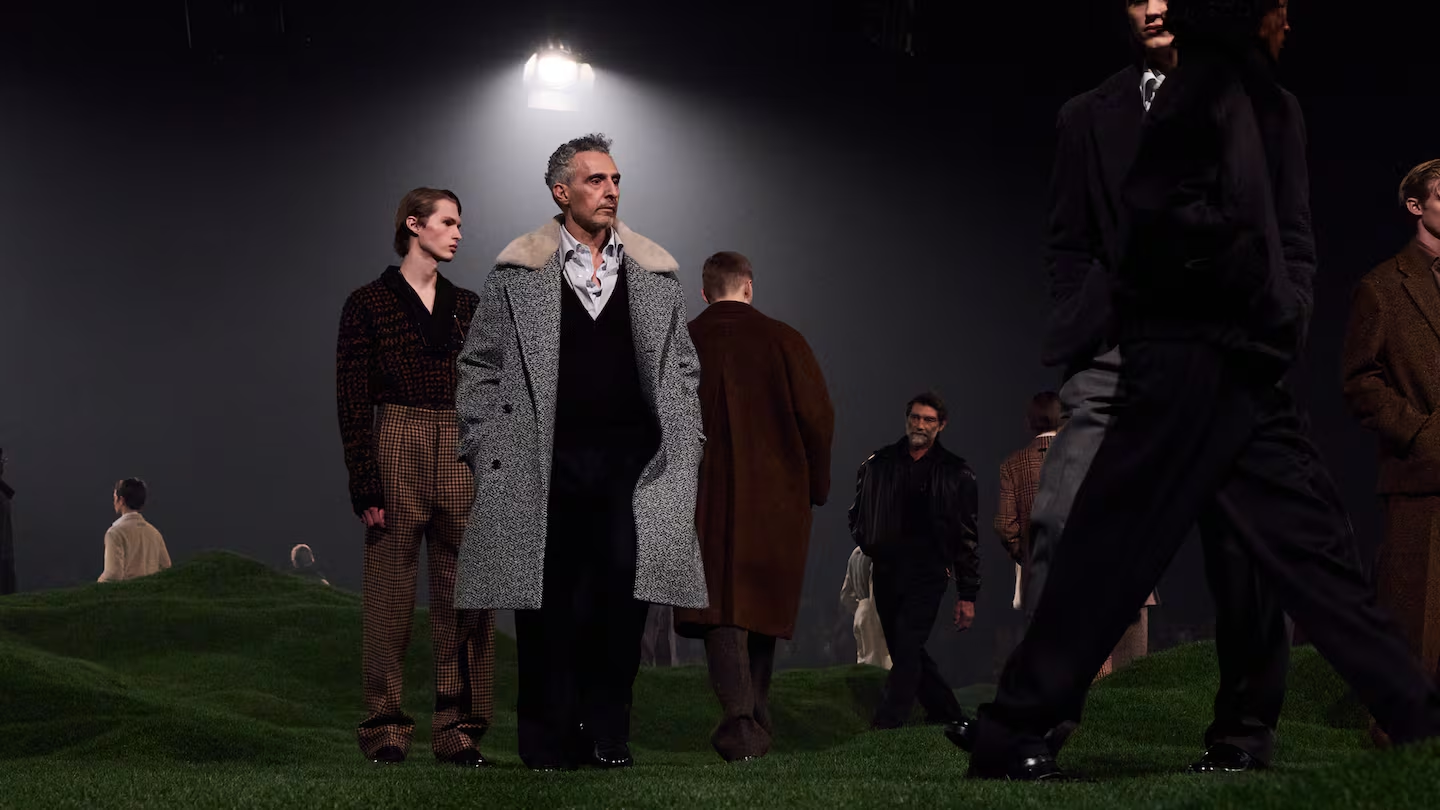
Quiet luxury was never a formal market segment. It was a description — part trend label, part retail shorthand — for clothes that signaled expense through cut, fabric, and discretion rather than an obvious monogram. In 2023, the phrase became a near-universal caption for neutral tailoring, cashmere, leather goods without visible hardware, and the television wardrobe of *Succession*.
Two years on, the useful question is not whether quiet luxury is “over.” It is what the phrase changed once the novelty wore off. The answer is narrower and more consequential: it changed the language brands use to defend price, the way retailers merchandise basics, and the kind of status signal a customer can buy. It did not make fashion less branded. It made branding more flexible.
Luxury’s recent slowdown makes the timing clearer. McKinsey and The Business of Fashion’s State of Fashion: Luxury 2025 describes a deteriorating value proposition after several years of steep price increases and unusually strong demand. Its prescription is not “remove the logo”; it is to clarify a brand’s core values, priority clients, assortment, price architecture, and experience.
That is almost a business definition of quiet luxury. The aesthetic offered a way to make a high price feel rational: the buyer was paying for wool quality, construction, fit, and longevity, not merely recognition. The promise was especially useful when aspirational customers became more price-sensitive and when the conspicuousness of a logo could feel out of step with economic uncertainty.
The data does not prove that understated clothes caused resilience, and no major company reports “quiet luxury” as a line item. But company results show why the proposition mattered. LVMH reported that Fashion and Leather Goods revenue fell 5 percent organically in 2025, to €37.77 billion, after a difficult period for luxury fashion; the group’s 2025 results also describe local customers as resilient even as the division remained under pressure. The inference is straightforward but limited: customers did not stop wanting luxury, but brands had to work harder to explain why it was worth the money.
Quiet luxury moved “wardrobe building” from a stylist’s private vocabulary into mass retail merchandising. A camel coat, unmarked loafer, fine-gauge knit, or softly structured bag could now be sold not only as an item but as proof of discernment. The commercial unit became the system: a quiet capsule, a tonal wardrobe, a collection of pieces designed to appear compatible across seasons.
That system has practical advantages. It increases the number of occasions for a purchase, makes repeat buying easier, and gives a brand permission to charge for material and finishing rather than novelty. It also makes products more legible on resale platforms, where condition, fabrication, and recognizable shape can matter as much as a seasonal print.
But the aesthetic’s language was quickly standardized. “Timeless” became a justification for familiar silhouettes; “investment” became a way to soften the fact of a high price; “stealth wealth” became a logo of its own. The contradiction was built in. Once every brand could photograph a beige coat against a plaster wall, restraint stopped being a rare signal and became a repeatable visual code.
The strongest evidence against the “death of the logo” story is the continued importance of brand identity in luxury’s economics. A logo, monogram, signature hardware, or house color is not just decoration: it is an authentication shortcut, a memory device, and often a resale asset. Removing it entirely would discard some of the very equity that allows a house to command a premium.
What changed was the acceptable volume and placement of the signal. A discreet clasp, a recognizable proportion, a tonal monogram, or a branded experience could do the work that a large chest logo once did. The signifier became modular: quiet for the office, visible for the social feed, and highly legible to people who already know the code.
This is also why the phrase “logos in disguise” is more accurate than “no logos.” The customer may not want overt display in every setting, but the purchase still depends on a distinction between a branded luxury object and an anonymous good. Quiet luxury did not abolish conspicuous consumption; it made conspicuousness more dependent on cultural fluency.
Fashion’s visual cycle has already begun to widen. Reporting on the 2025–26 style shift points to color, prep, maximalism, and clothes with more personality, including exuberant runway details from brands associated with minimalism. That does not invalidate quiet luxury. It shows that a useful wardrobe proposition can survive after its dominant image loses novelty.
The next phase will reward brands that can combine restraint with a point of view. McKinsey’s State of Fashion 2026 frames the broader reset around balancing distinct customer segments and integrating product, storytelling, and client experience. In practice, that means a house cannot rely on “quiet” as a substitute for design. The garment still needs an idea, the price still needs evidence, and the customer still needs a reason to choose this version of a coat over the many versions already in the market.
Two years on, quiet luxury has become less a look than an operating brief. It pushed brands to articulate quality, versatility, and longevity, even when those claims were sometimes only atmospherically supported. It also revealed the limit of restraint as a universal answer: consumers eventually want color, humor, craft, and visible personality as well as discretion.
The durable change is not that logos vanished. It is that luxury now has to earn the right to show them. A discreet product can be expensive, but discretion alone is no longer proof that it is worth the price.