Profile
Rachel Scott on Craft, Context, and the Expansive Language of Diotima
Hannah R. Harris / Aug 8, 2026

As department stores narrow their footprints and assortments, independent and mid-size labels are rebuilding wholesale around fewer accounts, tighter buys, and better customer intelligence.
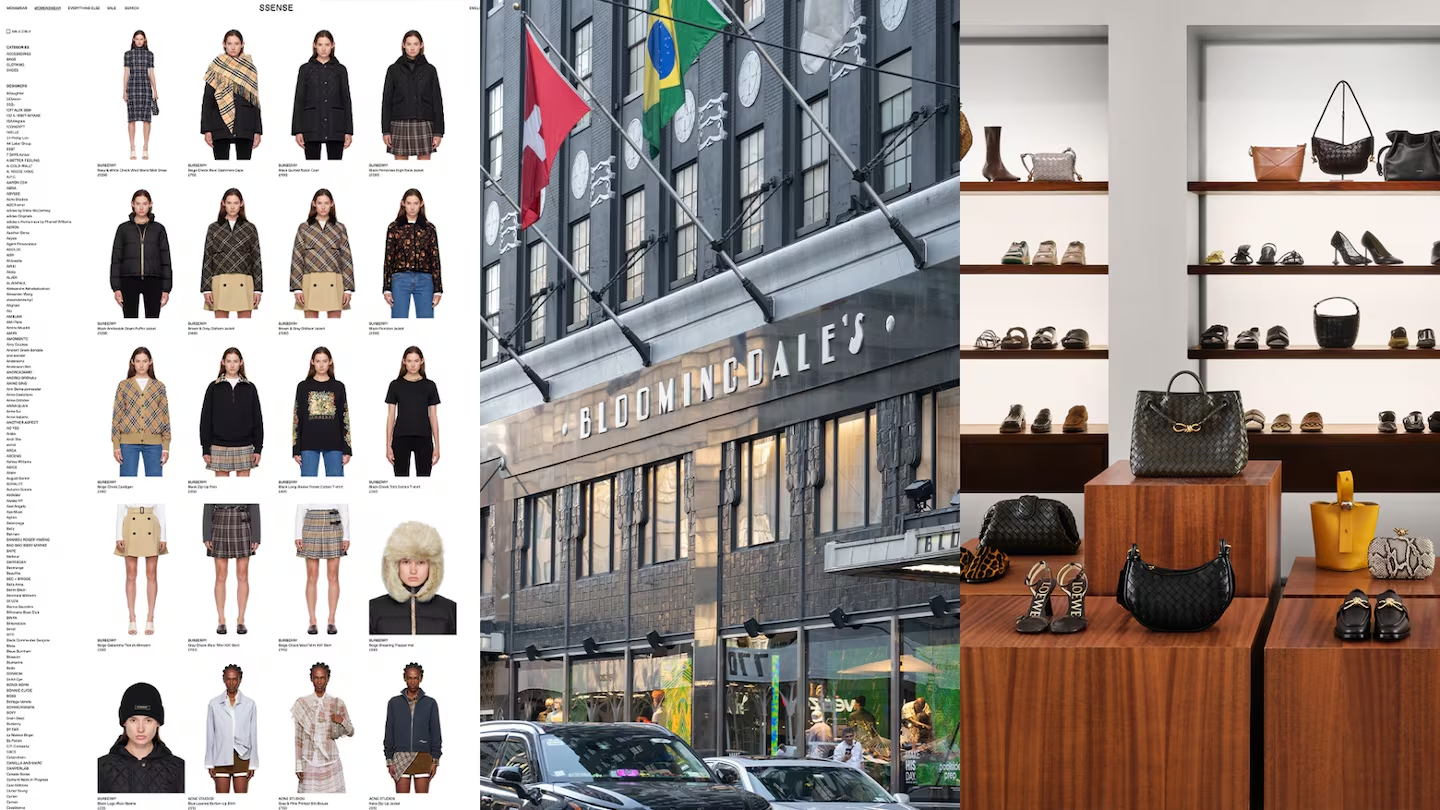
Wholesale is not disappearing. It is losing its status as fashion’s automatic route to scale. In 2026, the useful question for an independent or mid-size label is no longer how many doors it can enter. It is how many accounts it can serve without surrendering cash, inventory control, and the customer relationship that makes the next collection easier to sell.
That change is arriving from both sides of the rack. Department stores are shrinking, consolidating, and redrawing their assortments around the locations and categories they believe can win. Brands are responding with smaller account lists, fewer styles per delivery, and a more demanding expectation that a retail partner will provide more than a purchase order. The new currency is not reach alone. It is productive reach: the right customer, in the right market, with enough context and data to make the next buy more intelligent.
The 2026 restructuring of Saks Global made the shift impossible to treat as background noise. In January, the company entered Chapter 11; in June, it emerged as Exemplar Luxury Group, the parent of Saks Fifth Avenue, Neiman Marcus, and Bergdorf Goodman. During the process, the retailer announced closures across its Saks and Neiman Marcus footprint and said its go-forward network would prioritize the best-performing locations and markets with the highest concentration of luxury customers. The company also said that more than 500 brands had resumed shipping and released nearly $1.3 billion in retail receipts. Those figures are company-reported, and they describe inventory flow rather than independent proof of retail health, but the strategic message is clear: fewer, more concentrated locations are being asked to do more work. Exemplar Luxury Group’s March update
Macy’s is following a different version of the same logic. Its June 2026 first-quarter release reported 3.0 percent comparable-sales growth and said the company was investing in its Reimagine 200 stores, while Bloomingdale’s posted a company-reported 10.2 percent comparable-sales increase. The story is not every department store failing; it is a retailer concentrating resources on a defined fleet, sharper assortment, and nameplates with a more specific proposition. Macy’s describes the strategy as a combination of relevant product, improved experience, and disciplined investment.
For a label, a wholesale map based on historical prestige is no longer enough. A famous address still matters, but only if its floor space, buyer attention, staffing, and customer density can make a small collection visible. A smaller specialty store can be the better commercial and editorial fit.
Wholesale offers advantages an owned channel cannot immediately reproduce: geographic discovery, local credibility, store labor, and customers who may encounter the brand without searching for it. It also carries costs that are easy to hide inside a growth plan: samples, delivery coordination, minimums, terms, returns, markdown exposure, and the risk that buyer attention moves on before the product has a fair chance.
That is why a smaller account list can be a growth strategy rather than a retreat. A label can build depth in a few markets, replenish what is moving, and give each retailer a line that feels edited rather than diluted. The goal is not exclusivity. It is legibility.
Ralph Lauren’s latest annual filing offers a useful mature-company comparison. Its wholesale products were sold through approximately 9,500 full-price doors worldwide as of March 2026, with the majority in specialty stores; its luxury lines were distributed through a limited number of premier fashion retailers. The company also reported that its three largest wholesale customers represented about 11 percent of total net revenue. The principle is clear: scale can coexist with selective distribution, and concentration should be measured rather than romanticized. The filing is available through the SEC.
The risk runs in both directions. G-III Apparel Group’s fiscal 2026 filing reported that Macy’s, including Macy’s and Bloomingdale’s, accounted for 20.6 percent of its net sales. That does not make the relationship unhealthy; it makes the dependency visible. For smaller labels, one large account can represent an even greater share of the business, turning a delayed payment or canceled order into a company-level event. G-III’s filing is a reminder that diversification is about keeping one buyer’s decision from becoming the balance sheet.
The tighter wholesale model changes what gets shown to a buyer. Instead of presenting the entire line and hoping the retailer finds a commercial story inside it, brands are building smaller capsules around clear jobs: an entry product, a signature silhouette, a repeatable color, a statement piece, and the supporting sizes or accessories that make the rail feel complete.
This is inventory discipline. A narrow buy makes demand easier to read, production easier to stage, and replenishment easier to authorize. It gives the retailer a reason to place the product intentionally rather than let it disappear into a crowded category. The best account is not necessarily the one that orders the most at market; it is the one that can explain the product, place it coherently, and report what happened next.
Target’s expansion of the independently owned KBB by KAHLANA illustrates the test-and-learn version of this model. Target said shoppers generated more than 135,000 back-in-stock alerts for popular styles before it expanded the label to twice as many stores as at launch. That company-reported signal from one retailer is not proof that every small label should chase mass distribution. It does show the appeal of a controlled capsule: widen the proposition after demand is visible instead of taking a full seasonal gamble. Target’s February 2026 announcement
The implication for independent fashion is practical. A label should enter an account with a replenishment plan, a size-and-color thesis, and a definition of success that survives the first markdown meeting. Tighter assortments are not an excuse for thin product. They are a demand for sharper product.
The most important negotiation may not be the number of doors. It may be what the brand learns from them.
Wholesale gives a label access to customers, but not automatically to their names, permission, fit notes, or future intent. Those boundaries vary by contract and privacy regime. The reasonable ask is not raw personal data but usable, permissioned, and aggregated intelligence: sell-through by style and size, return reasons, wait-list behavior, replenishment timing, and regional differences.
Owned channels remain essential because they turn a transaction into a relationship the label can continue to develop. But direct-to-consumer requires acquisition spending, fulfillment, customer service, and a steady flow of content. The stronger model is a ledger in which each channel has a job: wholesale supplies discovery and local trust, while the brand site supplies explanation, continuity, and consented customer learning. Appointments, pop-ups, and events can connect the two.
That is also why the retailer’s own data sophistication matters. Exemplar’s post-restructuring plan emphasizes customer insights, curated assortments, and personalized service. When a multi-brand partner can turn its customer knowledge into better placement and faster decisions, it becomes more useful to a label. When it can offer only volume and a quarterly sales report, the brand is financing access to an audience it cannot see.
The 2026 wholesale reset is therefore not a return to the old wholesale-versus-DTC argument. It is a demand for selective partnership. Independent and mid-size labels should choose accounts for fit, full-price credibility, geography, service, and learning—not simply for prestige or scale. The best wholesale relationship will be smaller than the old ambition, but more accountable: fewer styles, fewer doors, better replenishment, clearer cash terms, and a path back to the customer.
My editorial judgment is simple: wholesale should be treated as a portfolio of specific bets, not a badge of arrival. If an account cannot say what it adds beyond reach, it is not a partner; it is a dependency. Fashion’s next durable labels will not reject the department store. They will make the department store earn its place in the system.