Profile
Rachel Scott on Craft, Context, and the Expansive Language of Diotima
Hannah R. Harris / Aug 8, 2026

Es Devlin's 15-metre illuminated reply to Natalia Goncharova's Firebird backdrop animates V&A East Storehouse through October 18, with choreography by Botis Seva and performance by Joshua Shanny-Wynter.
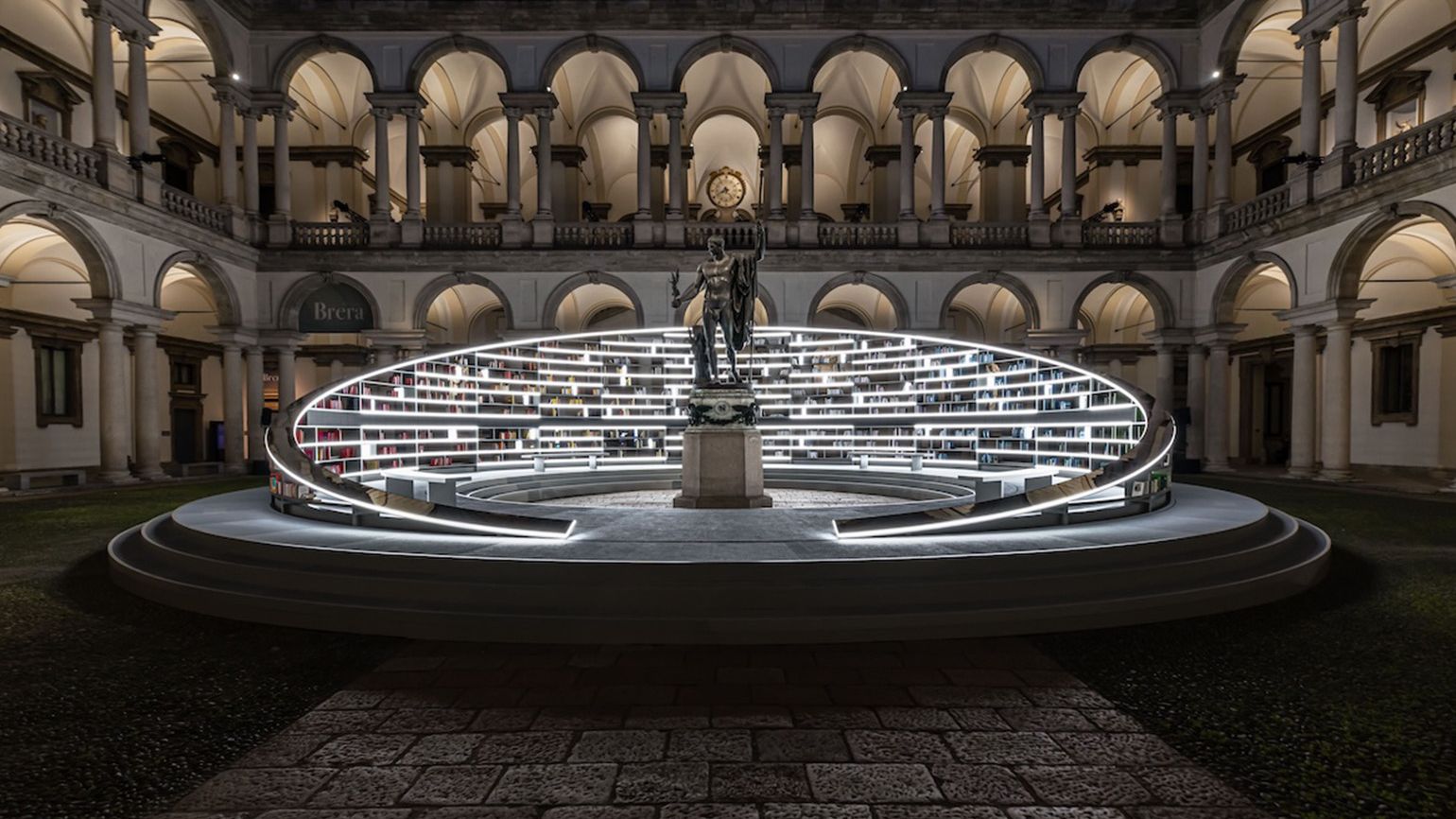
Every 90 seconds, a 15-metre-wide sculpture at V&A East Storehouse lights up in sequence while a recorded voice reads over a composed soundtrack. That is the entire visible mechanism of The Everythingists, Es Devlin's commission responding to Natalia Goncharova's 1926 painted backcloth for the Ballets Russes production of *The Firebird*, on view in Gallery 2 through October 18, 2026. Devlin drew and painted a shadow dance within the movements of dancer Joshua Shanny-Wynter, who appears suspended between enlarged iPhone boxes, forms that echo both Igor Stravinsky's *Firebird* score architecture and the V&A's own storage crates. The recorded voice is Devlin's, reading texts by Goncharova, Cory Doctorow, Clark Ashton Smith and Adrienne Rich over a score built by the duo Polyphonia, Jade Pybus and Andy Theakstone, drawing on the horn solo from Stravinsky's finale.
"Like Natalia Goncharova, many of us consider ourselves 'everythingists': centaurs, human animals dancing with our machine shadows," Devlin has said of the piece, in text displayed with the installation. It is a tidy line, and it is also the one most likely to end up as the entire public understanding of who made The Everythingists. That would be a mistake, and it is the mistake this piece exists to correct.
Botis Seva choreographed the movement Shanny-Wynter performs. Associate designers Zoe Diakaki and Anna Niamh Gorman worked the piece from concept into built form. Scena fabricated it. Richard Williamson and Sysco handled the lighting installation that produces the 90-second illumination cycle. Polyphonia composed and produced the score. None of those names appear on the wall label in the size Devlin's does, which is standard practice for a commission credited to a single artist, and also the exact convention this piece's own subject matter argues against. A work built from choreography, dance, composition, fabrication, programming and conservation is not a solo object with helpers. It is a compact production, closer in structure to a stage show than to a sculpture that one person carved.
That structure surfaced directly in how the work was made. Feedback from a youth collective involved in developing the piece led to a real change in the final choreography: the figures became more dynamic, no longer held tightly within the surrounding architectural forms but appearing to push against, move through and break beyond the structures around them. A single credited author cannot register that kind of input. A production team can, because a production team is what actually built The Everythingists, iteration by iteration, with Devlin directing the whole.
Fashion borrows stagecraft constantly: runway sets built with the scale and lighting logic of theatrical production, campaign imagery that leans on choreography and sculptural staging borrowed wholesale from performance design. What fashion rarely borrows alongside the look is the credit structure, the practice of naming the choreographer, the composer, the fabricator and the lighting designer alongside the creative director whose name goes on the invitation. The Everythingists, and the V&A's own documentation of how it was made, is unusually specific about who did what. Seva's choreography, Polyphonia's score, Diakaki and Gorman's design work, Scena's fabrication and Williamson and Sysco's lighting are each nameable, separately, with a distinct function in the finished work.
That specificity is the argument, not a footnote to it. A famous name attached to a large, technically ambitious object tends to absorb credit for the whole apparatus around it, whether or not that absorption is intended. The Everythingists gives the reader who wants to look past the headline name a full list of who actually built the machine that runs, illuminated, every 90 seconds, in a gallery that used to be a warehouse for the things a museum could not fit on its main floor.