Profile
Rachel Scott on Craft, Context, and the Expansive Language of Diotima
Hannah R. Harris / Aug 8, 2026

Cecilia Vicuña returns to the East London of her 1970s exile for a six-decade Whitechapel Gallery survey opening October 7, ending with a city built from driftwood, feathers and bones.
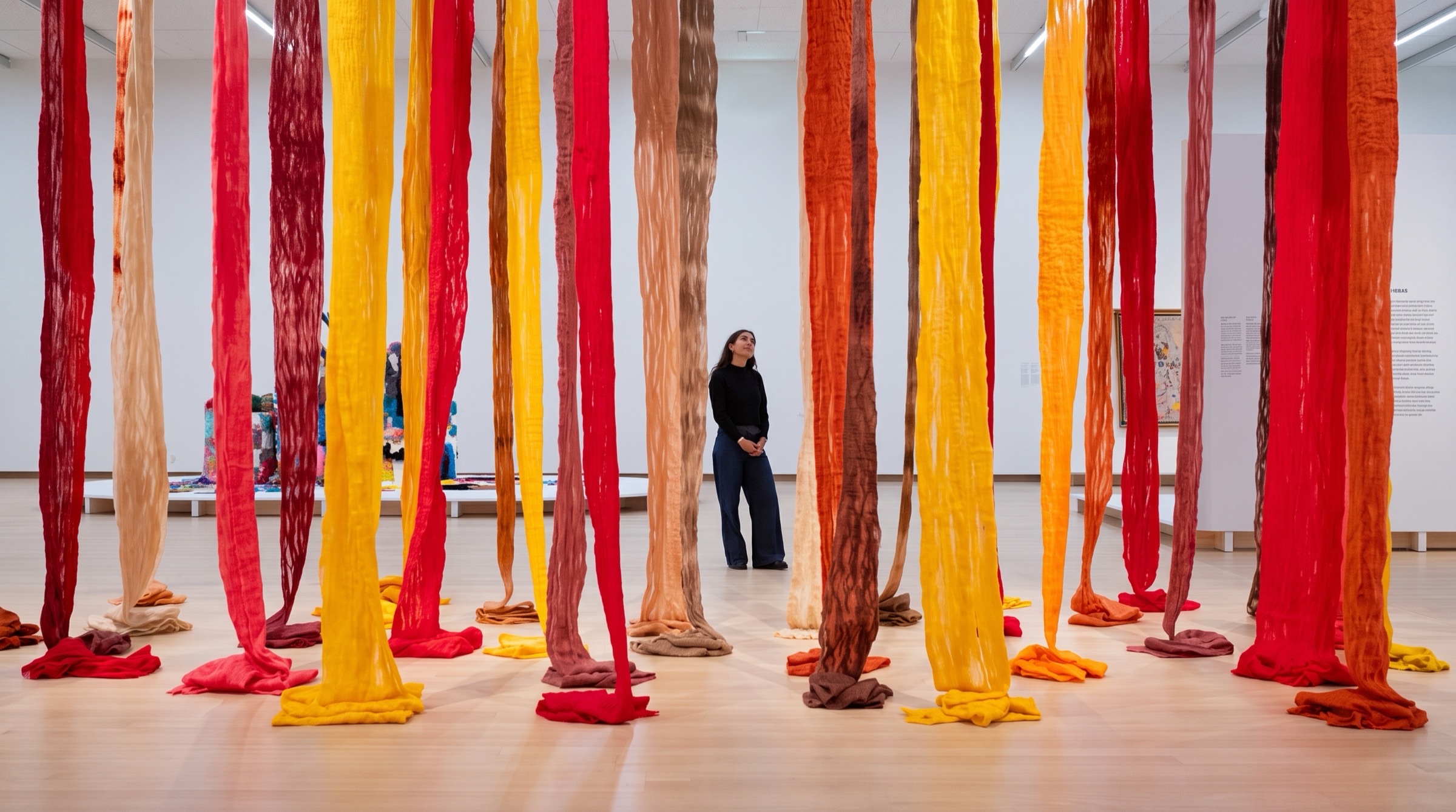
Cecilia Vicuña has been tying quipus for more than 50 years, and the first work a visitor meets at Whitechapel Gallery this autumn is one of them: Quipu Menstrual, a dense hanging sculpture of unspun wool in vivid reds and browns, made between 2006 and 2024. The exhibition, titled simply Cecilia Vicuña, opens October 7, 2026 and runs through February 14, 2027 across Galleries 1, 2, and 3, the artist's first major UK survey, spanning six decades of painting, textile, performance, film, and activism. Vicuña, born in Santiago, Chile in 1948, builds a practice around a form the Inca used for record-keeping before the Spanish conquest suppressed it: knotted cord as a non-alphabetic system for storing memory. Her quipus have always argued that a textile can hold information as rigorously as a written archive, if a viewer is willing to read touch instead of text.
The London setting is not incidental. Vicuña left Chile for London in the early 1970s, in self-exile after the 1973 military coup, and studied at the Slade School of Art from 1972 to 1974 out of a studio in Stepney Green, a few minutes from where Whitechapel Gallery now stages her survey. London at that moment was, as the gallery's own account puts it, a hub where artistic experimentation and political organizing were deeply intertwined, and Vicuña worked inside that overlap. The exhibition includes a surviving example of her precarios from that period, small sculptures assembled from paper, prints, fabric, feathers, and other found materials, alongside documentation of roughly 400 related works now lost. The precarios were built to disappear. Photographing them was, for decades, the only way most of them survived at all.
That deliberate impermanence is the show's spine. The final room holds Ciudad Geométrica, a large new installation from 2025 built from driftwood, feathers, shells, and bones gathered across Belgium, Chile, and New York, its structures echoing the sculptural logic of pre-Hispanic Andean architecture without claiming to reconstruct it. A city built from beach debris does not compete with stone or bronze on durability, and it is not trying to. Vicuña's materials choose the opposite argument: that a monument's authority does not have to come from its capacity to outlast the people who made it. A quipu of unspun wool, a precario likely to disintegrate, a city of driftwood assembled for one exhibition and dismantled after, all carry the same premise, that political memory can travel through something that requires care, repair, and repeated attention rather than something engineered to need none.
That premise cuts directly against how value gets assigned in most of the markets adjacent to Vicuña's work, fine art and fine jewelry both, where durability is treated as a proxy for seriousness. A house calls its output built to outlast trend and fashion cycles entirely, and the claim leans on the object's physical persistence, the idea that gold and stone will still exist in a hundred years, therefore the meaning attached to them will too. Vicuña's quipus and precarios refuse that logic outright. They argue that meaning survives through the attention of the people who keep returning to it, not through the object's resistance to decay. The 400 lost precarios did not disappear because they failed. They disappeared because that was always the deal, and what remains, in photographs and in the handful of surviving pieces at Whitechapel this winter, is proof that fragility was never the same thing as forgetting.