Profile
Rachel Scott on Craft, Context, and the Expansive Language of Diotima
Hannah R. Harris / Aug 8, 2026

With Centre Pompidou closed for renovation, Brancusi's rarely lent sculptures, tools, furniture and studio photographs travel to MoMA for The Artist and His Studio, opening October 25.
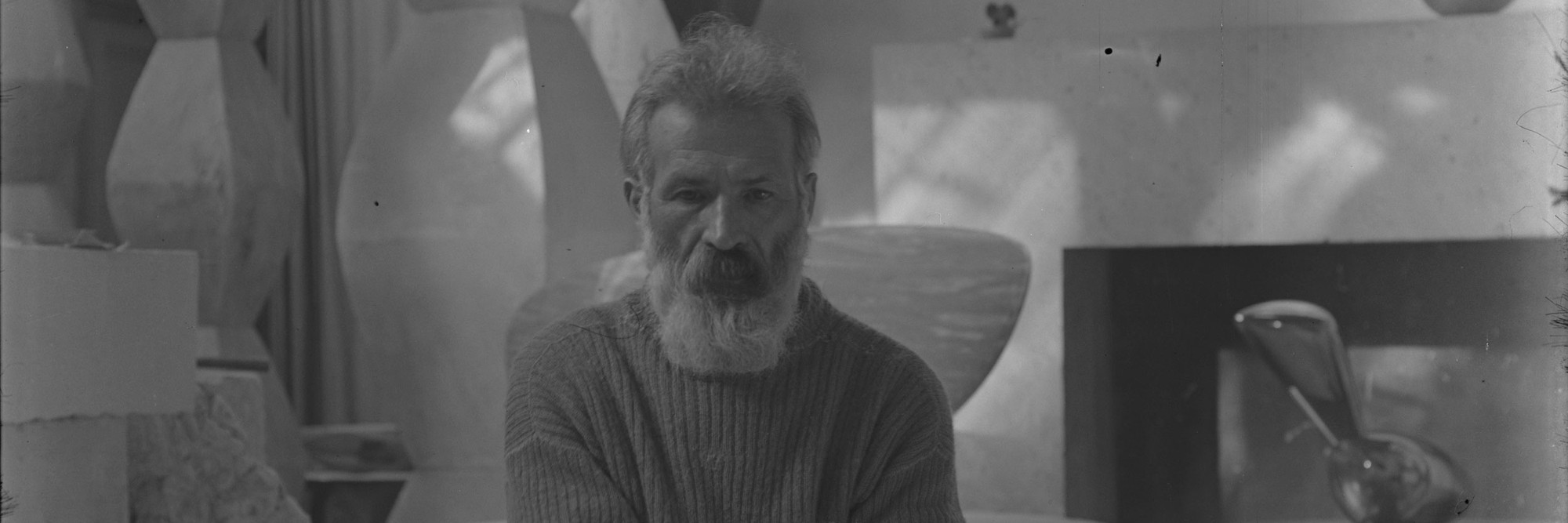
Constantin Brancusi died in 1957 and left his entire studio, at impasse Ronsin in Paris, to the French state on the condition that it be reconstructed exactly as he kept it: sculptures, tools, furniture, the base blocks he carved and re-carved as plinths, the photographs he took of his own work under changing light. That bequest has lived at Centre Pompidou since 1997, rebuilt as a freestanding structure beside the museum. Now, with the Pompidou closed for renovation, a substantial portion of that studio is crossing the Atlantic. Brancusi: The Artist and His Studio opens at the Museum of Modern Art on October 25, 2026, and runs through February 27, 2027, organized by guest curator Anne Umland with assistant curator Mia Matthias.
It is a rare loan, made possible only because the building that normally holds the material is shut. MoMA's own exhibition listing frames the show around the studio itself as an environment, not a backdrop: Brancusi treated the room as a working material in its own right, arranging and rearranging plaster casts, marble, and wood blocks in relation to one another, photographing the results, and revising the arrangement again. The furniture he built and the tools he used are traveling alongside the sculpture, which is the part of this exhibition worth paying attention to. A retrospective of Brancusi's finished carvings is one kind of show. A retrospective of the room he made them in, and never stopped rearranging, is a different argument entirely.
Any time an institution moves a studio, it makes a hundred small editorial decisions that get presented as simple preservation. Which tools go on which shelf. Which half-finished blocks count as work versus debris. Whether the arrangement reflects the studio as Brancusi left it at his death in 1957, or as it has been maintained and lightly tidied through nearly seven decades of institutional care since. The Pompidou's own reconstruction, built from Brancusi's photographs of the space as documentary evidence, is already one remove from the original room at impasse Ronsin. Sending a selection of that reconstruction to New York, arranged again inside MoMA's sixth floor, is a second remove.
None of this is a criticism of the exhibition. It is a description of what a studio-as-artifact necessarily is: an authored object, arranged like any other, dressed in the language of authenticity. Brancusi himself understood this better than most twentieth-century sculptors. He was the one who photographed his own studio obsessively after taking up the camera in the early 1920s, using the images not as documentation but as compositions in their own right, deciding what the room should look like before anyone else got the chance to decide for him.
Fashion houses have picked up the same instinct in recent years, converting a founder's atelier or workroom into a museum piece, complete with the worktable, the pins, the half-finished toile left artfully unfinished. Brancusi's bequest is the sophisticated version of that same move, made seven decades before anyone thought to apply it to a maison. What his studio's move to MoMA makes visible, better than almost any comparable show, is the gap between a working room and a memorial to one. The tools are real. The dust, the sequence, the accidents of where something got left, those are curatorial choices now, made by people who were not in the room when the decisions were first made. That gap is not a flaw in the exhibition. It is the argument the exhibition cannot avoid making, whether or not it says so on the wall label.