Profile
Gucci Westman on the Art of Making Beauty Feel Like Yourself
Kayla M. Walker / Aug 8, 2026

The brow cycle is moving from laminated uniformity toward visible shape, pigment, and personal technique, with consequences for the category's product architecture.
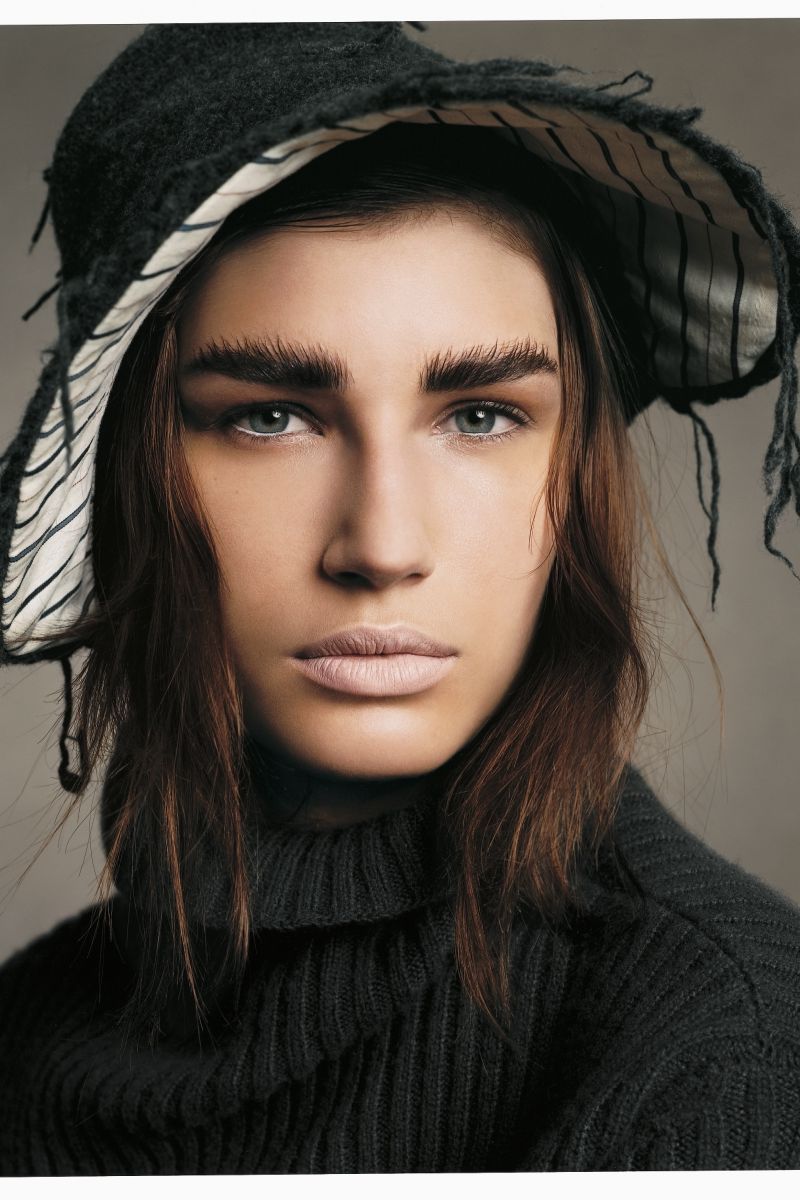
The brow is having another turn at being a face rather than a finish. After several seasons in which laminated hairs, lifted fronts, and brushed-up uniformity offered the dominant answer, artists and consumers are making room for density, pigment, shape, and visible decisions. The change is not a simple return to one thick arch. It is a return to the idea that a brow can be drawn, softened, sharpened, bleached, pierced, or left visibly imperfect according to the rest of the look.
The evidence is on the runway. In its report from London Fashion Week, Vogue recorded pierced brows and a skinny, sharply turned shape by Thomas de Kluyver at Simone Rocha, bleached brows at Richard Quinn, and brushed-up brows by Amy Conway at Emilia Wickstead. Three different treatments share a useful fact: the brow is no longer being asked to disappear into one polished template. It is being used as styling.
Lamination made the brow a styling problem with one highly legible solution. The hair was softened, brushed upward, and fixed in place. The visual promise was fuller density without a drawn edge, an architecture that looked finished before the rest of the face began. The treatment also made the costs visible. Allure's account of brow lamination describes the chemical softening and setting process, along with the risks of treating delicate skin around the eye.
That look was well suited to the years when beauty moved toward a low-contrast, skin-first surface. A brow that looked groomed but not drawn supported the same preference for diffused complexion and restrained color. The current shift is connected to a wider appetite for personality. Reporting on 2026 beauty trends, Vogue cited Spate data showing searches for bold makeup up 22.2 percent year over year and described statement lipstick, pigmented blush, and strong eyebrows as part of the return to experimentation.
The distinction matters because bold does not mean maximal. A brushed brow can be bold when the hairs are dark against a bare face. A narrow brow can be bold when its angle is deliberately graphic. A powder-filled brow can be bold when it carries enough opacity to balance a saturated lip. The newness lies in the relationship between brow and face, not in a single measurement of thickness.
Runway artists are useful here because they treat the brow as a compositional line. De Kluyver used placement and ornament to make the brow part of the garment's attitude. Conway's brushed-up version at Emilia Wickstead kept the rest of the makeup minimal, proving that a visible brow can support restraint as easily as drama. The work of artists is influencing consumers less by dictating a finished shape than by showing how many variables are available.
That plurality is also visible in 2026 brow coverage. Vogue's reporting on the flat brow describes a straight shape as a way to alter the visual line of the face without asking every wearer to remove the natural arch. The useful lesson for brands is that technique can be sold as choice. A customer may want to soften an arch, extend a tail, add a hair stroke, deepen the front, or simply hold an existing shape in place.
The product implication is a move from one hero format to a system. Benefit Cosmetics lists more than 100 brow solutions, including pencils, powders, gels, and waxes, and says its assortment covers 12 natural-looking shades. Its own product page shows the category logic clearly: a pencil creates structure, a fiber gel creates volume, and a setting product fixes the result. The consumer may buy one item, but the brand sees a sequence of jobs.
Brands should resist reading the moment as permission to relaunch a single dark pencil. A bolder brow requires more precise shade architecture because hair, skin, and desired intensity do not always share a color. A cool deep brown, a soft black, a neutral taupe, and a red-leaning brunette can produce different effects at the same depth. The range also needs translucency. A pencil that only deposits an opaque block cannot serve the customer who wants to build density gradually.
The mix should therefore include at least four distinct functions: hair-like precision, soft filling, directional styling, and reliable hold. Tinted gels and fibers can add density without asking a customer to redraw the whole brow. Powders can create a softer edge. Pomades can support graphic work but need tools and education. Clear gels remain relevant because the return of pigment does not eliminate the need for control. The opportunity is in the handoff between formats, not in multiplying near-identical brow pencils.
This is a useful place to remember that the category is built on repeat use. Brow products are small, portable, and easy to demonstrate. They can sit beside complexion, eye, and hair styling without requiring a new ritual. But a brand that treats the brow only as an add-on will miss the reason it is returning. The customer is looking for a way to alter the face with precision. Education, shade naming, and application tools are part of the product, even when they do not sit inside the component.
The return will keep its value if brands let it remain plural. A strong brow can be natural-looking, graphic, straight, brushed, bleached, or deliberately overdrawn. The category does not need another universal brow. It needs a better vocabulary for the choices that make a face look like itself.