Profile
Gucci Westman on the Art of Making Beauty Feel Like Yourself
Kayla M. Walker / Aug 8, 2026

Layering is turning fragrance from a single spray into a behavior, a formulation challenge, and a way for brands to build a considered basket across scent formats.
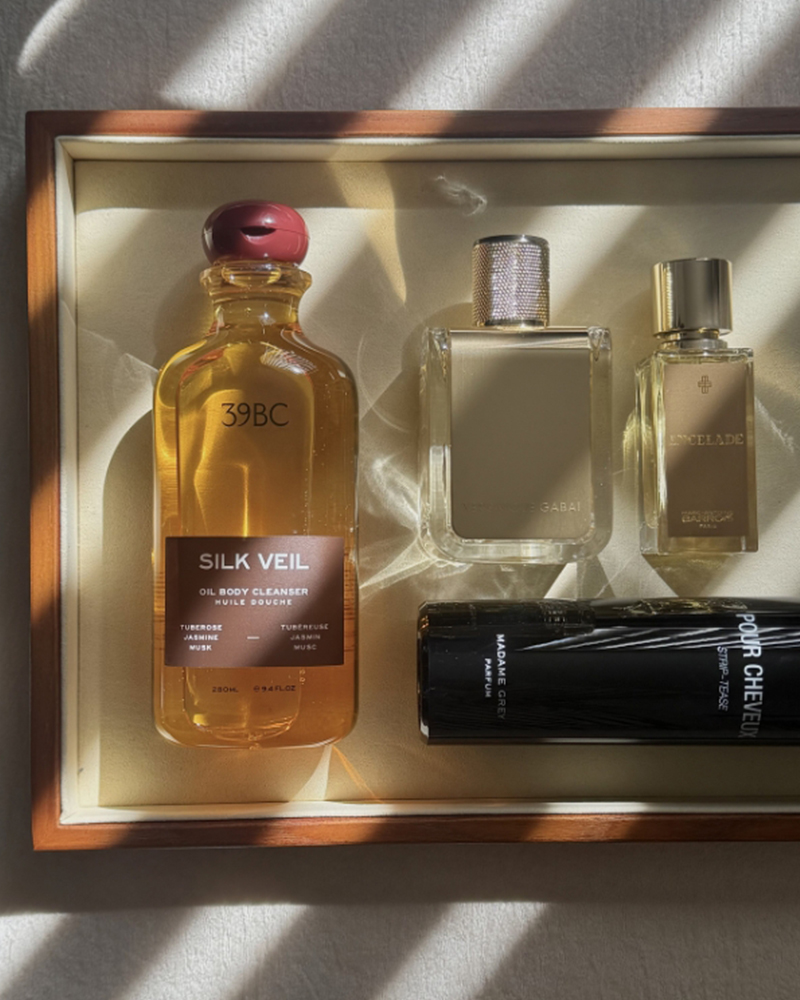
Fragrance layering is usually described as a creative game. For the customer, it can be a way to make a familiar scent feel private. For the industry, it is a shift in behavior from choosing one bottle to building a sequence of products that meet the skin, the fabric, and the room at different moments. The commercial promise is real. So is the formulation work required to make that promise responsible.
Circana's 2026 beauty overview names scent layering and personalized perfumes among the forces reshaping fragrance. Coty has been more explicit about the basket logic. In its fiscal 2025 results, the company described a push into hair and body mists under brands including Calvin Klein and philosophy, alongside a broader focus on fragrance adjacencies. The move turns scent from a single item into a ladder of entry points.
Consumers already layer without using the term. A scented body wash is followed by lotion, then an eau de parfum. A hair mist may be used when a skin spray feels too direct. A travel format can make reapplication practical. The difference now is that brands are naming the behavior and giving it a more deliberate architecture.
The strongest layering systems separate roles. A body product can establish a close, lower-intensity base. A mist can add diffusion and make the ritual feel lighter. An eau de parfum can provide the main structure. A concentrated oil or extrait can be reserved for a small amount at a pulse point. The point is not to make every product equally loud. It is to control distance, duration, and texture.
That architecture changes the basket. A shopper who begins with a discovery set can move into a body lotion, a hair mist, a travel spray, and eventually a full bottle. The sequence also gives retailers more occasions to demonstrate fragrance. A customer who does not want to commit to a large bottle may still accept a smaller format or a scented body product. The brand gains trial without pretending that every shopper needs five products at once.
Layering is not a loophole around dosage. The International Fragrance Association explains that its standards govern the safe use of fragrance ingredients and are applied through product categories and implementation timelines. An IFRA conformity statement for a fragrance mixture is tied to its intended use. It is not a blanket approval for every combination a customer may invent across skin, hair, and body products.
The United States regulatory baseline is also specific. The Food and Drug Administration says fragrance ingredients in cosmetics must meet the same safety requirement as other cosmetic ingredients and must be safe when used according to labeled directions or customary use. The FDA also notes that fragrance formulas can be listed generally as fragrance or perfume because they may be trade secrets. That makes clear communication about use especially important when several scented products are designed to be worn together.
Brands should formulate the system as a system. That means checking how the body product, mist, and fine fragrance behave on their own, defining the intended use of each, and making the suggested order and amount easy to understand. It also means avoiding a claim that a customer can endlessly add sprays without changing the experience. More concentrate does not automatically create more refinement. It can create a louder, less balanced result and may increase the chance of irritation for people who are sensitive to fragrance components.
The consumer side deserves equal clarity. The FDA's fragrance guidance notes that some people can be allergic or sensitive to fragrance ingredients and that US cosmetic labels may not identify every fragrance component individually. A responsible layering guide should recommend following each label, trying one new product at a time, and stopping when the skin reacts. A brand that gives this advice is not weakening the fantasy. It is showing that the fantasy has been engineered.
There is a temptation to treat layering as an excuse to sell a collection. That is the least interesting version of the idea. A good system gives the customer a reason for each format and a vocabulary for changing the result. A clean musk can soften a sharper floral. A citrus body mist can give lift to a woody fragrance. A lotion can make a scent feel closer without asking the wearer to increase the spray count. The examples should be built around olfactive contrast and compatibility rather than a list of products.
This is also where discovery becomes merchandising. Retailers can display a fragrance beside its body and hair formats, but they should show the sequence, not simply stack the bottles. Sampling cards can describe the role of each product. A travel spray can be positioned as a way to test a combination over a day. Discovery sets can include pairings that teach the customer what changes when a base note is added, rather than presenting five unrelated vials.
The model rewards brands that can maintain a recognizable signature across formats. It punishes brands that copy a fine fragrance into every base without accounting for the different feel, evaporation, and contact time of a lotion or mist. The formula needs continuity, but not sameness.
The habit gives perfumery a useful place between self-expression and product design. It invites experimentation while keeping the chemistry visible. Brands that respect dosage, disclose use, and build real compatibility can make the larger basket feel earned. The rest will produce louder bottles and call the noise personalization.