Profile
Gucci Westman on the Art of Making Beauty Feel Like Yourself
Kayla M. Walker / Aug 8, 2026

In 2026, runway beauty is moving through artist teams, brand partners, social clips, and retail pages before the show lights have cooled.
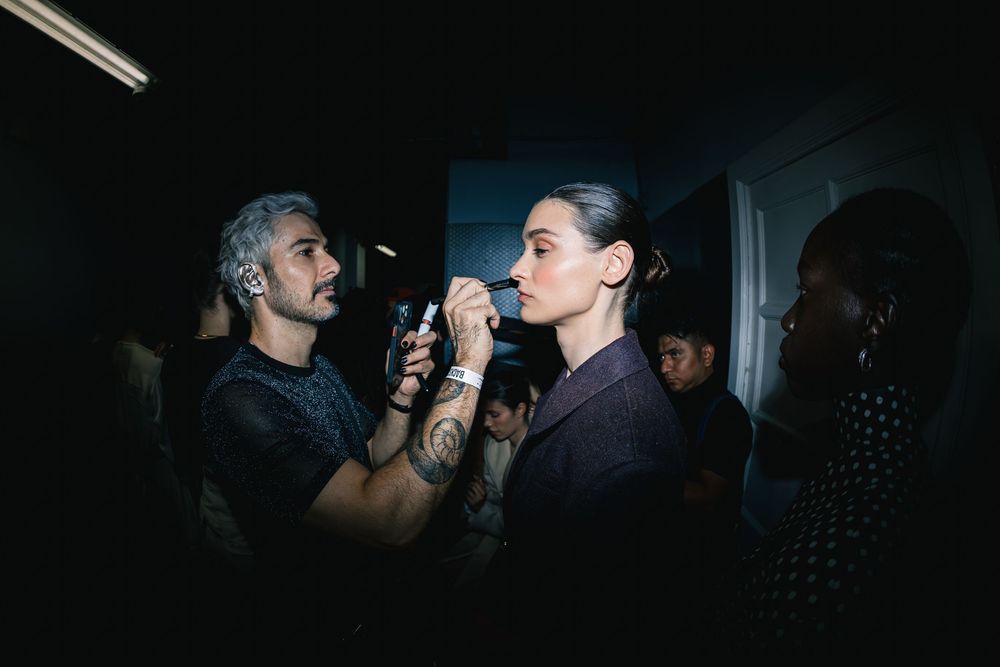
The runway image is the public artifact. The trend is made earlier, in a backstage room where a makeup artist tests a shade under hard light, a hairstylist changes the proportion of a part, and a brand team decides which products can survive a hundred faces in a few hours. By the time the first model walks out, the look has already passed through creative direction, production limits, sponsor agreements, and a distribution plan for the clips that will follow.
The 2026 season makes that chain unusually visible. The Council of Fashion Designers of America scheduled more than 60 runway shows and presentations for New York Fashion Week's fall-winter season from February 11 to February 16. The number matters less as a spectacle than as a production condition. Artists are building distinct visual languages inside a dense calendar, while brands are looking for a close-up that can travel beyond the room.
At Dior's fall-winter 2026 show in Paris, makeup artist Peter Philips and hair artist Guido Palau worked from Jonathan Anderson's idea of the Tuileries as a place for people to see and be seen. Vogue's backstage report described a fresh complexion and eyes with a restrained black accent, while Palau developed loose pieces around the face. The look was not a product demonstration. It was an interpretation of the collection's social setting, translated into skin, hair, and movement.
The distinction matters. A designer supplies the world. The artist decides what can be read at runway distance, what survives a camera flash, and what can be repeated across different faces and hair textures. At Proenza Schouler and Diotima in New York, Vogue reported on February 15 that makeup artist Thomas de Kluyver deconstructed elements of a classic makeup look, while hairstylist Holli Smith built a low ponytail that appeared rushed but required precision. The apparent looseness was a technical result, not a lack of process.
That process is why artist teams set trends more reliably than isolated screenshots do. Their choices are tested under time, light, movement, and multiple model castings. When an artist explains a technique in a backstage clip, the audience receives a method as well as an image. The method is more likely to become a retail behavior because it can be repeated with products that already exist.
Fashion week is also a partner system. For London's February 2026 season, the British Fashion Council named OMODA principal partner and listed TONI&GUY among official partners. Its current fashion-week platform is designed as a year-round digital hub for industry professionals and consumers to view and buy collections. The beauty implication is direct: the event is no longer finished when the show closes. Its content is built to remain available, searchable, and commercially legible.
Shiseido's own report on Paris's fall-winter 2026 season shows another model. From March 2 to March 10, the company's hair and makeup artists worked with several brands, including CFCL. The artist is therefore connected to a group of shows and a repeatable professional network, not just one designer's post. A sponsor can supply products, personnel, training, and credibility while the artist supplies the judgment that makes the products visible without turning the runway into a catalogue.
The commercial test is whether that judgment can move into a product pipeline. Dior's official page for the latest Jonathan Anderson show turns Philips's runway work into a consumer menu: Dior Forever Skin Glow foundation, Dior Backstage Rosy Glow Stick, Dior Addict Lip Maximizer, and Dior Backstage Airflash Mist. The page creates a direct bridge from show image to product page. A consumer does not have to reconstruct the look from a caption or wait for a seasonal editorial to explain it.
The backstage clip is now a unit of distribution. It can show a brush placement, a hair tool, a product texture, or the artist's hand moving across a model's face. Unlike the full runway, the clip isolates one decision. A sponsor can reuse it in retail training, a brand can cut it into product education, and a creator can turn it into a tutorial. The artist's technique becomes the connective tissue between editorial coverage and shopping.
This is where product pipelines can distort the trend. A vivid runway color may be converted into a limited shade because it photographs well. A skin finish may become a primer launch. A complicated hair construction may be reduced to a styling product and a simplified instruction. The translation creates access, but it can also flatten the original idea.
The strongest examples are built as systems. The artist tests the idea. The sponsor makes the backstage operation possible. The show creates a high-resolution image. Social video breaks the image into actions. Retail turns those actions into a product path. The cycle ends when a customer can reproduce part of the look without losing the reason it existed.
Fashion week will continue to generate more beauty images than any consumer can absorb. The useful signal is narrower. Watch for artists whose work has a clear technique, a documented product relationship, and a route from backstage explanation to retail availability. In 2026, that is how a runway idea stops being a picture and becomes a category event.