Profile
David and Sybil Yurman: A Life in Art, Made Wearable
Hannah R. Harris / Nov 20, 2025

Contemporary art moves into Chicago's most extravagant historic home, Wharton Esherick leaves the woods, The New Yorker turns 100 and more American openings.
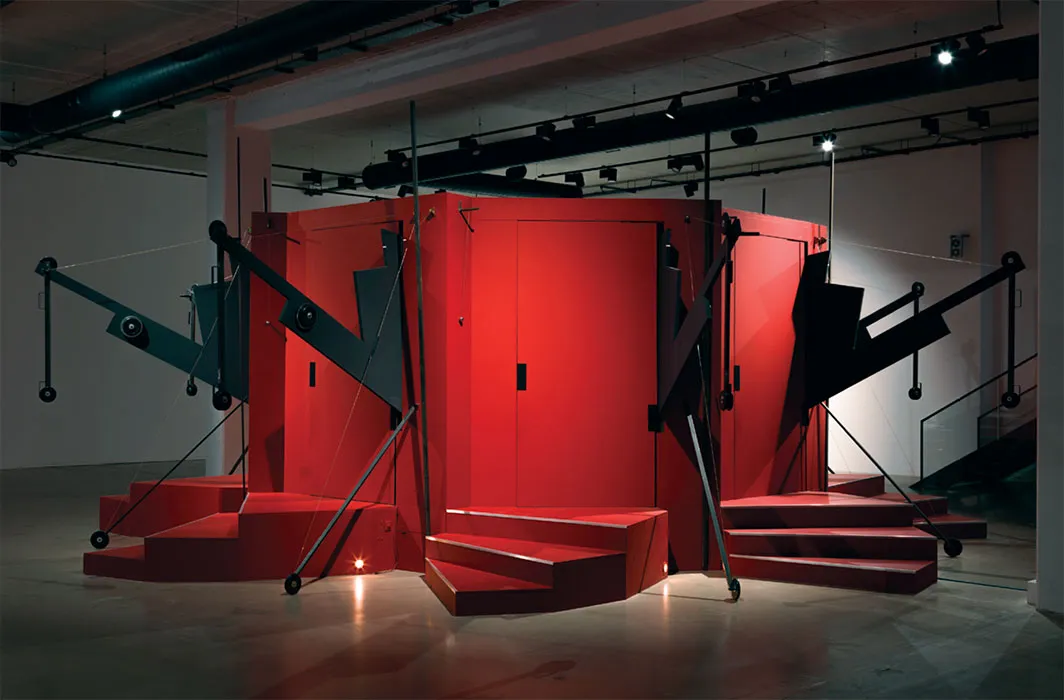
Pedro Gómez-Egaña makes installations, performances and sculpture that unsettle a viewer's sense of time and space. For his first museum exhibition in the United States, the Colombian-born artist looks to the architectural corrections and optical tricks of the Parthenon. A moving set resembles an apartment whose walls shift, repeat and refuse to stay where domestic walls should. The familiar room becomes a reminder that architecture is always shaping the way we move, look and behave.
The Driehaus Museum occupies the former home of banker Samuel Nickerson, completed in 1883 and once considered Chicago's most expensive residence. Onyx, carved wood, stained glass and 17 varieties of marble still advertise its Gilded Age ambition. For the museum's largest contemporary exhibition, 14 artists respond to the materials and stories embedded in the house, from its lost taxidermy to the delicacy of the windows and Nickerson's early adoption of electric light. The old mansion is not merely the setting. It is the assignment.
Wharton Esherick moved into the woods outside Philadelphia in 1913 intending to paint. He began carving frames, discovered that wood held his attention more completely and spent the next 55 years turning an ordinary craft material into sculptural furniture and architecture. Curved tables, a twisting staircase and a dovetailed fireplace all came from the same restless hand. His former home and studio contains nearly 3,000 works but remains a destination for those who know to look. This exhibition brings a wider selection to Madison.
Harold Ross and Jane Grant launched The New Yorker in 1925 with a promise of gaiety, wit and satire. A century later, the New York Public Library has 2,500 boxes through which to tell the story. Typewriters used by William Shawn and Lillian Ross appear beside manuscripts, founding papers, photographs, correspondence from J.D. Salinger and, naturally, cartoons. The exhibition turns a familiar weekly object back into the unruly pile of people, drafts and decisions from which it came.
Julien Creuzet represented France at the 2024 Venice Biennale, becoming the first French-Caribbean artist and one of the youngest artists to take on the pavilion. Raised in Martinique and based in Paris, he works across sculpture, video, poetry and music to examine diaspora and French colonial history. At Brown University, he reshapes the Venice presentation with 17 works, including six large steel sculptures, animation and song. Thread, beads, color and sound fill the gallery as water becomes a route through colonialism and the transatlantic slave trade.