Profile
Rachel Scott on Craft, Context, and the Expansive Language of Diotima
Hannah R. Harris / Aug 8, 2026

At the Venice Biennale through November 22, artist Adebunmi Gbadebo coils clay taken from ancestral burial plots into vessels that bind Edgefield pottery, African technique and funerary remembrance.
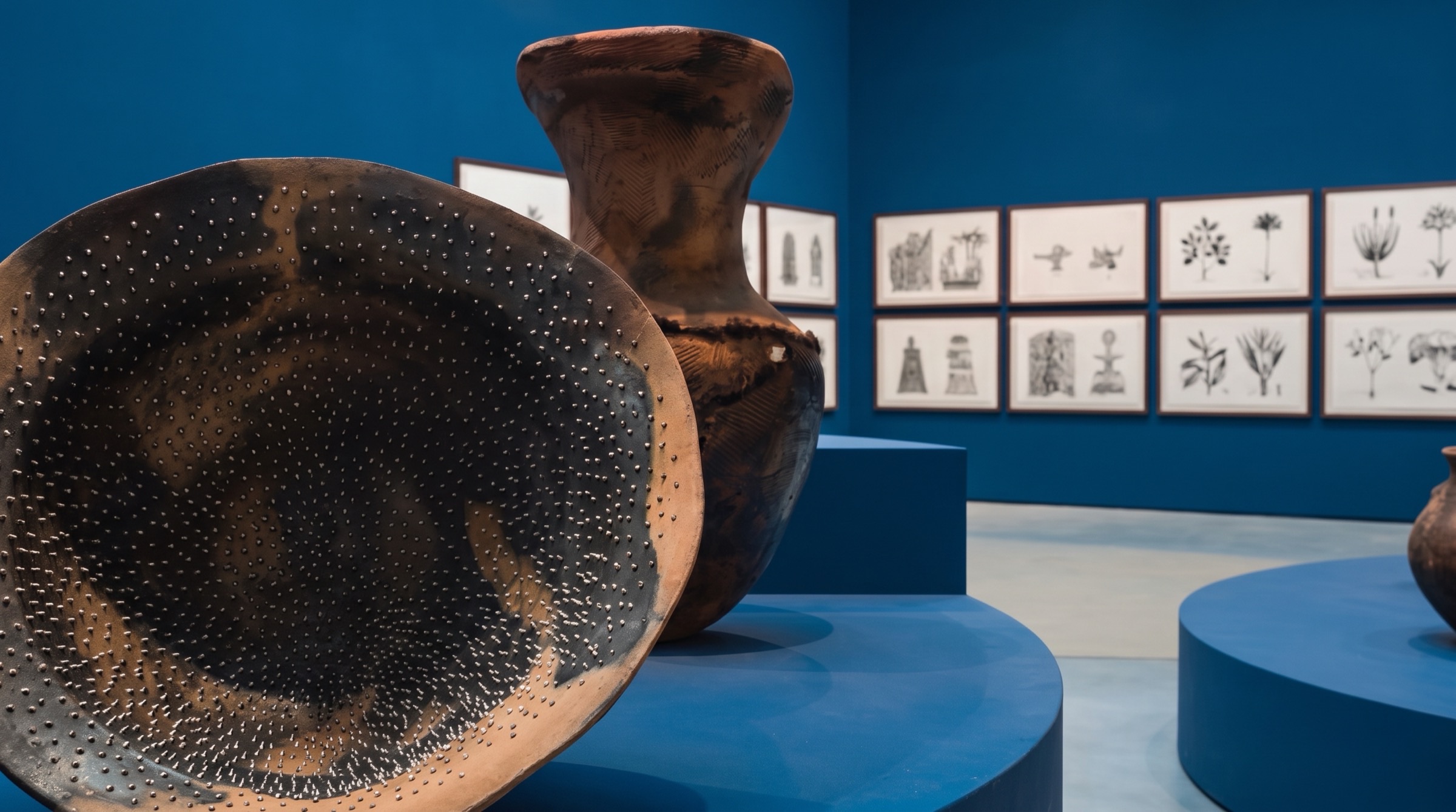
The red soil Adebunmi Gbadebo works with is dug from burial plots at True Blue plantation in South Carolina, the ground where her ancestors were forced to labor. She mixes it into clay by hand, coils it into vessels using a method rooted in Nigerian and Cameroonian pottery, and fires forms that echo the work of the Old Edgefield potters, the enslaved and formerly enslaved African American ceramicists who built a tradition in that same soil two centuries earlier. Some of the resulting vessels incorporate rice. Others carry human hair and afro locs, materials Gbadebo has used across a decade of work built from soil, rice and hair to recover lives that slavery's paper archive left out.
The vessels are on view now in the Central Pavilion of the 61st Venice Biennale, part of *In Minor Keys*, the exhibition Koyo Kouoh was developing before her death in May 2025 and that her selected team completed, running May 9 through November 22, 2026 in the Giardini. Placed among the international pavilions and their material flexes, gold leaf, marble, engineered composites, Gbadebo's unglazed red forms register differently. They are not demonstrating what can be done with clay. They are insisting on where the clay came from.
Provenance in the market sense is a paper trail: a certificate, a chain of prior owners, a line that establishes an object's legitimacy after the fact. Gbadebo's practice refuses that sequence. The burial ground is not background information appended to the work once it exists; it is the condition under which the work exists at all. Digging the soil is an act with its own weight before a single coil is turned. That inversion, provenance as an ongoing relationship with the dead rather than a document attached to the living transaction, is what separates these vessels from craft objects that happen to reference history.
The poet Nikky Finney, named among the artist's collaborators and supporters, wrote a text that accompanies the work: "The wide river of you moves through us as I touch you back into egg-shaped catamarans and point your face south to Africa. By the kinks and curls of your buried follicles I drag you up from the frozen red clay." The line does what Gbadebo's forming process does: it treats excavation as retrieval of a person, not extraction of a raw material.
The work sits within a wider network of support, including Cheryl R. Riley and Courtney Sloane among named collectors, Nicola Vassell Gallery in New York, and the Brodsky Center at the Philadelphia Academy of the Fine Arts, where Gbadebo has produced editioned prints alongside the ceramics. None of that infrastructure is incidental to how the vessels read. A market built to move objects quickly is being asked, here, to sit with material that was quarried from a grave.
Readers trained on fine jewelry and material luxury tend to locate value in scarcity: the stone that took longest to find, the hand that took longest to train, the finish no other workshop can replicate. Gbadebo's vessels ask a harder question of that instinct. Her material is rare not because it is difficult to source but because of what sourcing it required and from whom it was taken. Ownership, in the conventional sense of buying and holding an object free and clear, sits uneasily against work made from ground where people were buried without their own consent to be there.
That discomfort is the point rather than an obstacle to appreciating the work. Gbadebo is not making an argument against collecting. She is making an argument about what collectors owe an object once they understand what it is made of. The vessels will circulate through galleries and eventually into private hands, the way most fired clay does. What she has built into them, permanently, is the demand that whoever holds one also holds the fact of True Blue plantation, the Old Edgefield potters, and the labor neither the market nor the museum wall label can fully absorb.