Profile
David and Sybil Yurman: A Life in Art, Made Wearable
Hannah R. Harris / Nov 20, 2025

Sapphires and tourmalines edge out diamonds in this year's red-carpet picks.
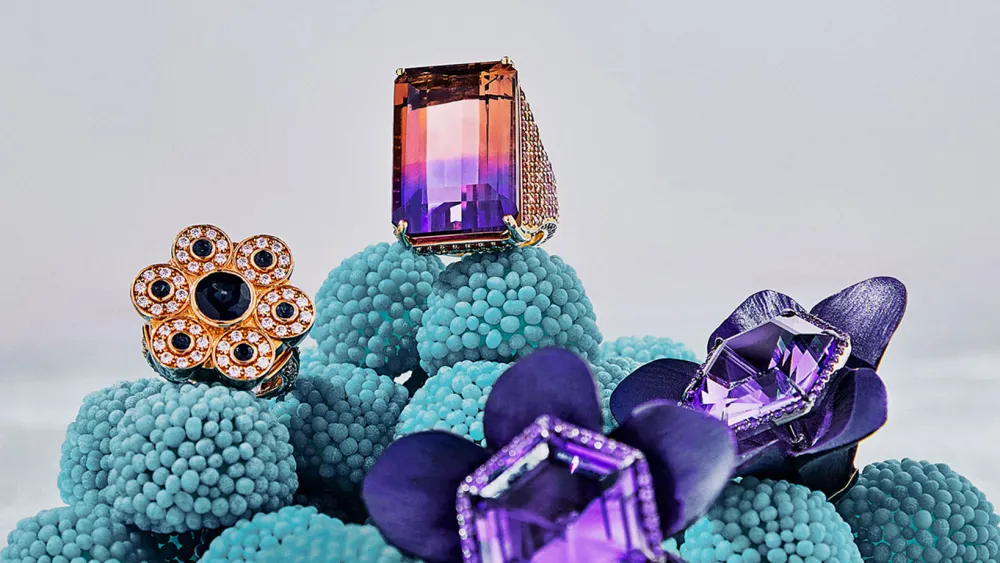
A red carpet loan begins as paperwork. The piece leaves the house with a courier, insured at replacement value, under an agreement naming the event, the date, and the hour it comes back. Nothing about that process changed this season. What changed is what the boxes hold. On the pull lists VOL reviewed across this award season, the most requested categories were unheated sapphires in teal and steel blue, and tourmalines in the green-to-pink range, with diamond-centered pieces increasingly cast as the second option a stylist keeps in reserve rather than the first one she asks for.
Stylists have been circling color for several seasons, so the useful question is not whether the taste exists but why it converted now. Three things moved at once: the price of the metal a diamond usually sits in, the supply of the stones replacing it, and the paperwork a house can produce to prove what a colored stone actually is.
Gold did the first part. The World Gold Council has tied the metal's run to falling jewelry volume in the United States, and a gold-heavy setting is now a cost a client weighs against the stone it holds. That math favors lighter architecture built around one expressive center, which is the shape colored stone design already takes.
Supply did the second part, though not in the direction the trend would suggest. Gemfields reported emerald auction revenue of 78.6 million dollars in its 2025 update, roughly flat year over year, while ruby auction revenue fell to 49.9 million dollars from 117.2 million the year before. India's Gem and Jewellery Export Promotion Council has flagged the upstream version of the same problem: its cutting centers run largely on imported rough, much of it from artisanal mining, and tightening export rules in producing countries are limiting what reaches the bench. Demand is rising into a narrowing pipe. For award season that scarcity works as an argument rather than an obstacle, since a stone a house cannot easily replace is a stone worth photographing.
The auction record supplies the ceiling. Christie's June 2025 Magnificent Jewels sale in New York cleared every lot, with colored stones drawing the heaviest bidding and the Blue Belle, a 392.52 carat Ceylon sapphire, selling for 11.3 million dollars. Results at that level do not describe what anyone wears to a ceremony. They set the reference price a stylist can point to when she asks a client to consider sapphire over a graded round.
The quieter shift happened in reporting. From January 2026 the Gemological Institute of America extended country-of-origin reporting to opal, peridot and demantoid garnet, three categories that previously had no verifiable origin service at all. The Responsible Jewellery Council's March 2025 guidance drew the line the trade had been blurring: a gemological origin opinion describes where a lab believes a stone formed, a provenance claim describes a documented chain of custody, and the first must never be sold as the second.
That distinction is why color can now carry a carpet. A diamond arrives with a grading report the public half understands. Until recently a sapphire arrived with an assertion. A house that can hand over an origin report, a treatment disclosure and a clean custody trail is selling something a client can repeat to anyone who asks, which is the whole function of a piece worn under that many lenses.
Monica G. Hughes, VOL's contributing editor, expects the categories the labs opened up in January to show first in editorial and only later in retail. The trade show floor agrees with her sequencing. At AGTA GemFair in Tucson, GIA graders recorded unheated green, teal and steely blue sapphires as the strongest sellers, alongside a rise in bicolor and tricolor material and in cuts, hexagon, marquise and shield, that read as niche five years ago. Not one winning entry in the show's bridal design competition set a center diamond.
For independent houses the lesson is not to chase auction-grade rarity. It is to run the same discipline at working scale: state plainly what is known and unknown about a stone, price the setting as the variable it has become, and build repeat categories around personal palettes and birthstones rather than a single graded center. The risk has inverted. A diamond with a report is no longer the conservative choice, and a colored stone without documentation is now the difficult sell.