By Megan Lee
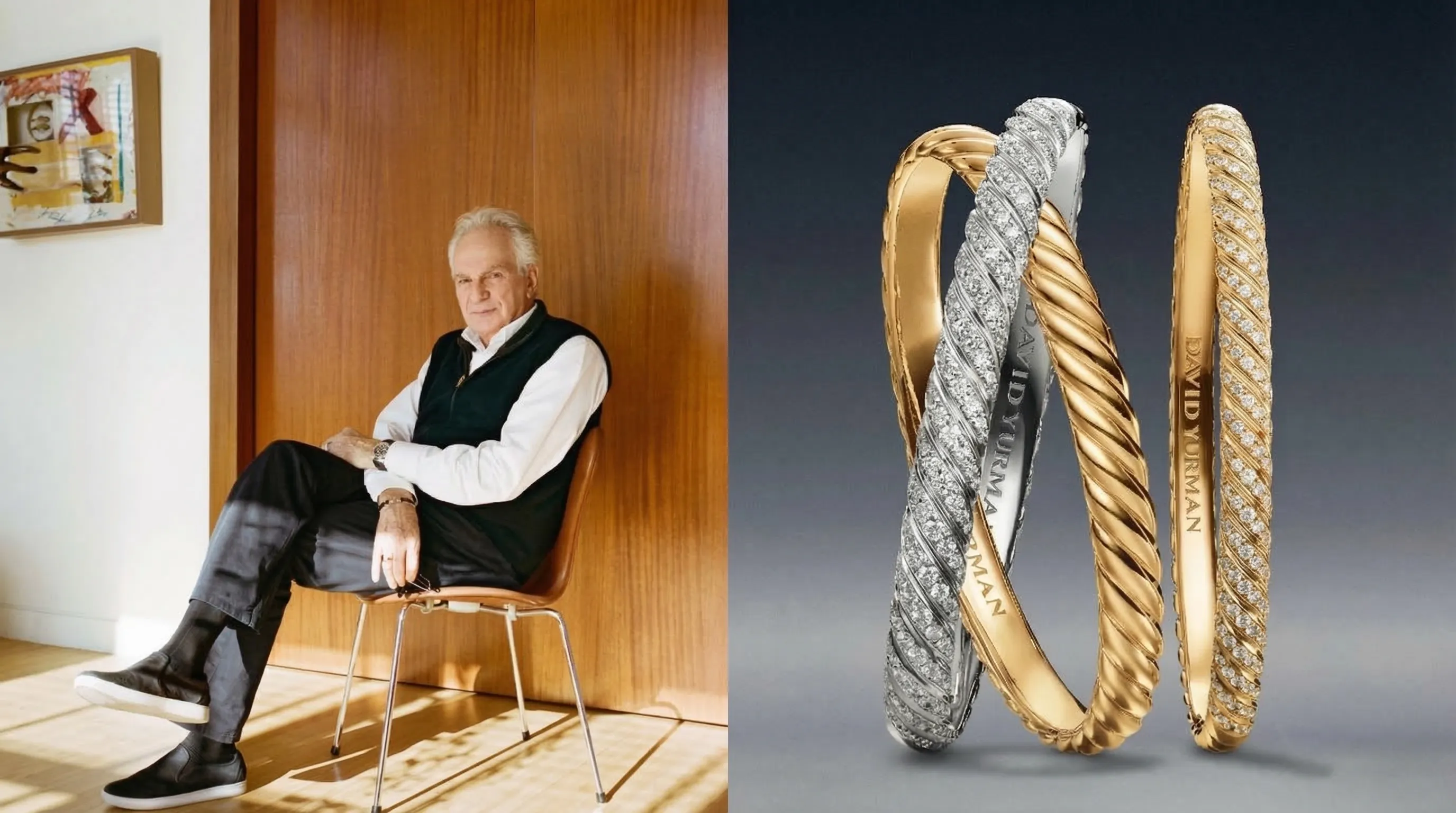
In their Tribeca headquarters — a space where David continues to sculpt, and Sybil paints, in a studio space adjacent to their home — David and Sybil Yurman sit side by side, finishing each other's sentences the way couples do after more than five decades together. Even the act of talking feels like a project done together: they finish each other's sentences or one will toss in colorful interjections while the other is speaking. Their jewelry company, founded in 1980, has become arguably America's most famous designer jeweler, but to hear them tell it, the whole thing was, in their own words, "one long art project."
Your love story is almost as famous as your jewelry at this point. But take us back — how did you actually meet?
Sybil: It was September of 1969. Tie-dye and bell-bottoms were all the rage, but I had my own distinct style. David was a foreman in Hans Van de Bovenkamp's sculpture studio in Greenwich Village, and he remembers seeing me for the first time when I applied for a job there. I had wild black hair and wore colorful Peruvian ponchos — both as a top and skirt.
David: She came in for the interview, met the woman, and then was introduced to our group of sculptors, and I was one of the men. She had a reaction. She asked who I was. She said, "Oh, is he married?" And the woman said, "No." Then it turns out I had asked about her.
Sybil: We liked each other from when we first met. He used to bring me coffee in the morning — I didn't tell him I didn't drink coffee. (Laughs)
David: Months later, she invited me over to her studio. I was just blown away by what she was doing. I thought, oh my god, she is a great talent. Not long after, I moved in. I'm welding. She's painting. Life is art.
You both came to art through wonderfully unconventional paths. David, you've called yourself "a terrible student." What was it that set you on this trajectory?
David: At the age of 11, I found a book in the local library depicting prehistoric cave paintings discovered in the caves of Lascaux, France. These raw images of paleolithic animals conveyed drama, movement, and beauty through simple lines, and that inspired me to follow an artistic path. School wasn't for me. We are symbols of runaway. I'm a hitchhiker, dyslexic, major ADD, flipping from this to that — the only thing that kept us together and focused was the love and passion of art. It's something that fed us. I ended up spending five years hitchhiking between New York's Greenwich Village and California — Venice and Big Sur — partaking in the Beatnik and San Francisco Renaissance cultural movements.
Sybil: My path was parallel but different. I found a passion for poetry and art. Enchanted by an exhibition of Monet's Water Lilies at the Museum of Modern Art, I explored the use of color by studying the French Impressionist painters. But I was also a restless student. I could never sit still. I was interested in everything. I really wanted to talk with people. I ended up dropping out of school when I was 15. They told my father that they wouldn't call the truant officer on me, because I would never graduate and never amount to anything.
David, before jewelry you were building monumental public art. Can you talk about that period?
David: After apprenticing under Jacques Lipchitz — I spent two years with him, learning the importance of artistic discipline, a clear sense of purpose, and mastery of materials. From there, I worked with various sculptors, including Theodore Roszak and Edward Meshekoff, doing large-scale public works. For Lincoln Center, I helped create the railings of the promenade in what is now the David H. Koch Theater, designed by Philip Johnson. I also worked on the eagle sculpture commissioned for the James L. Watson Court of International Trade in New York City. That background — understanding scale, structure, how metals behave — became the foundation for everything I'd later do in jewelry.
So how did the leap from sculpture to jewelry actually happen? The story of the Dante necklace is almost legendary.
David: My venture into jewelry making was largely unintentional. I designed a sculpturally-inspired piece for Sybil who wore it to an art gallery opening. The gallery owner asked to reproduce and sell my design. But I declined — it was too personal to share and sell commercially.
Sybil: It wasn't a missed opportunity in my mind — rather it was proof that there was a ready market interested in David's designs. I saw the business opportunity he didn't. He said "No," but I said "Yes!" I took the necklace off and left it with her. Within a few hours, four necklaces sold, and the iconic jewelry house David Yurman was born. Over the next 10 years, we drove cross-country, selling $1 million to $2 million worth of jewelry every year around the U.S., building a loyal brand following.
And then came Cable — the design that truly changed everything. What was the genesis of that idea?
David: It came from multiple places at once. The bronze rods used for my direct-welded sculptures inspired me to bundle similar strands of gold and dot them with diamonds — that became the Starlight Collection. Then a simple twist transformed the parallel wires of Starlight into the first piece of Cable jewelry. By hand, I shaped 50 feet of gold wire into the first Cable design, with pink tourmaline and emerald end caps.
I had also been spending a lot of time at the Metropolitan Museum of Art. When I was in my 20s, I would drive Sybil to her class at Hunter College and then visit the Met. The twisted design was partly inspired by the Brooklyn Bridge — "that strength and simplicity grabbed me." I also drew inspiration from ancient jewelry and a particular torque necklace design at the Met's exhibits.
Sybil: The company's big breakthrough came organically. When David welded, he would have these containers with long thin tubes, rods that he would take and melt. He would grab them, and sometimes he would tie them up, and they would make this look. The thing was to listen, to look. The idea started happening organically. It was, 'How does that incorporate into your visual language?' At one point, a manufacturer accidentally changed the design in a way that added to it — a fabulous mistake.
David: And that openness to accident and serendipity — that experience I had with Suzuki at the Zen Center, being exposed to the thinking of that time, where the main message is to be able to accept what the universe delivers and listen to it and just look at it and be able to take it in. It's not having a preconceived notion.
The Cable Bracelet is now one of the most recognizable jewelry designs in the world. How has it evolved over four decades?
David: Cable has become a symbol and a signature for us. It's the connectivity and the art of what we do. Today, there are now more than 2,000 iterations of this iconic aesthetic within the David Yurman lines. Throughout every collection, cable is used in innovative and beautiful ways — as a contrast to smooth polished metal, as an accent, a bead, a setting, a clasp, carved in stone. As a subtle signature, it often appears on the inside of a ring or back of a pendant where only the wearer will see it.
You also disrupted how jewelry was marketed. Your advertising campaigns with Peter Lindbergh were revolutionary. Most jewelers at the time were running static product shots.
Sybil: David and I have always worked towards having the imagery evoke joy, lightness, and life. It's a spirit of playfulness yet sophistication, and to signal empowerment and confidence.
David: We made a splash with campaigns featuring Peter Lindbergh's black and white images of supermodels. The emotion and sensuality of those photos were a divergence from the typical still-life jewelry ads of the time. We brought on brand ambassadors like Kate Moss, Amber Valletta, and Gisele Bündchen, and they weren't just wearing our jewelry — they were living in it. Our designs don't come to life until they're worn. What we are doing is fusing art, fashion, fine jewelry, design, and commerce.
There's a philosophy embedded in the brand about making luxury more democratic. Can you expand on that?
David: For years, people thought of luxury as not attainable or attainable by very few. We thought differently and wanted to make something more accessible — casual American luxury. It was opulent, but blending gold and silver made it more casual. The way the metals were balanced, you felt that there was this historic sense of opulence that you can wear with a jean jacket. So we were taking it and playing with it — just changing the vernacular. But it's still steeped in the tradition of classic art and fine jewelry.
Sybil: We've always chosen to bring the expression of our creations through the lens of art. All of our key players have not just been business partners, but creative collaborators. We wanted to integrate art into lifestyle.
You also challenged another taboo in the industry — setting diamonds in sterling silver. That was unheard of in 1997.
David: I became the first prominent designer to set diamonds in sterling silver. This was a bold and innovative departure from classic fine jewelry and transformed the industry's opinion of this technique. People in the trade were shocked. But it went back to our core belief — you don't separate the commercial and say, "Well, that's commercial. I want to be a fine artist." It's all the same. It's all art.
Let's talk about the next generation. Your son Evan is now President and Chief Creative Officer. How has he shaped the brand's future?
Sybil: Evan was born in 1982. Immersed in the world of jewelry from a young age, he would always have a substantial role in the Yurman brand.
David: Evan evolved Cable, our beloved form, with his own unique point of view, drawing inspiration from his love of architecture and bas-relief sculpture. The Sculpted Cable collection is a perfect example — he updated the original Cable's cylindrical pattern, rendering a new perspective that transforms the original helix into a flattened, carved relief.
Sybil: He also pushed us toward sustainability. Cable Edge is the company's jewelry collection made exclusively with recycled metals and traceable diamonds. By using metals that have previously been refined, the brand is reducing the demand for newly mined materials and the energy needed to process them.
You also believe strongly in giving back. Tell us about the Foundation.
Sybil: The David & Sybil Yurman Humanitarian and Arts Foundation was established in 2001 to award individuals who support charities and the arts through their donations and volunteerism. Past recipients include Steven Spielberg, Elton John, and Leonard Slatkin. The foundation also provides support for a variety of charitable initiatives, including The Whitney Museum of American Art, Studio In a School, The Breast Cancer Research Foundation, and the Make-A-Wish Foundation.
David: One of our most visible philanthropic efforts is the annual Pinky Ring Project, which raises funds for breast cancer research and awareness. The rings are inspired by a design I created for our daughter-in-law, who is a breast cancer survivor.19 That's when jewelry transcends decoration — it becomes a vessel for purpose.
After more than four decades, what keeps you both creating?
David: Art was always aesthetically pleasing but also functional; fine arts and applied arts were one and the same. That principle hasn't changed. The medium is just more intimate now. Every piece we make carries some part of our story — our love of ancient art, of sculpture, of the raw beauty of materials.
Sybil: Listen to yourself, listen to who you're selling to, and have the dance with the other person that you want to engage with. David did thousands of craft shows and gallery shows to meet the customers and learn how they're responding to what we were doing. We still approach it that way. Every person who puts on a piece of David Yurman is continuing a conversation we started in a Greenwich Village sculpture studio in 1969.