By Chelsea Hawkins
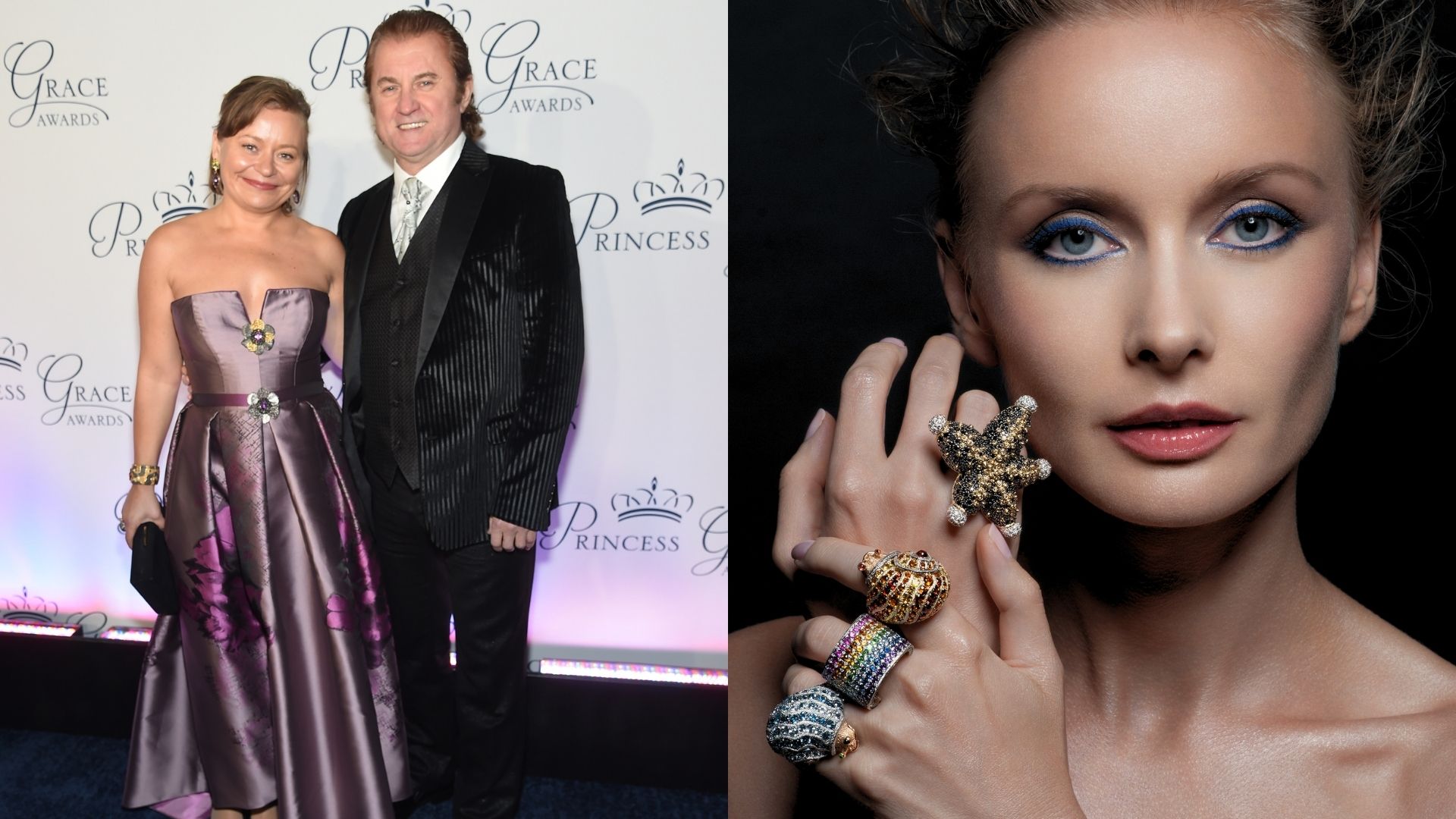
A Conversation with Maria Soldier of Alex Soldier
At the heart of Times Square, in a hidden Manhattan atelier, master jeweler and sculptor Alex Soldier handcrafts pieces that blur the line between jewelry and miniature sculpture. Known for his intricate textures, bold use of color, and signature metal “painting” techniques, his work is instantly recognizable, a world of snails, sunflowers, meteorites, and coronarias rendered in precious metal and gems, each piece a delicate work of art.
Behind the scenes, his daughter and executive director, Maria Soldier, serves as the bridge between bench‑level innovation and the way the world experiences the brand. Having arrived in the United States with her family in the early 1990s, she grew up inside the studio, watching the very first collection take shape and then helping to bring it to the global stage. Today, Maria oversees everything from client relationships and storytelling to high‑profile collaborations and custom commissions, ensuring that every Soldier piece is experienced as it was created: as art.
Can you take us back to that first independent collection in 1996?
Maria: I remember it vividly. I was in junior high, helping my dad prepare the collection for its debut. We had to go to New Jersey to meet Mort Abelson, the director of JA New York. My father showed him the first few pieces he had designed. Mort was incredibly impressed and told him he had never seen anything like this before, but he also warned him it would be tough to break into the market because his designs were ahead of their time.
When he debuted the collection at JA in 1996, people really did look at him like he was an alien. The work was so different from what the market was used to. Later, as his work evolved, he developed the Snail Collection and the Cocktail Collection, oversized cocktail rings that, at the time, were unlike anything anyone had seen in terms of scale and design. When I travelled across the U.S. showing them to stores, people would tell me, “This is too much. Our clients would never wear something this big.” Today those same proportions are considered a normal cocktail ring. The market shifted to meet him, not the other way around.
In 2002, he debuted his first snail encrusted with gemstones, the piece that won an AGTA Spectrum Award and caught the eye of Jeff Prine, then editor of LUSTRE and Modern Jeweler magazine. Jeff ran a full article on my father’s work, and that helped more people see what he was doing. But it was still a slow burn. His designs were simply too far ahead for that moment in time, which is a blessing and a challenge when you’re trying to build a business.
Alex is known for inventing his own tools and building signature metal textures by hand. What is the single most “Alex Soldier” technique — and how do you explain it to clients?
Maria: I always describe it as painting on metal. All of our signature textures are done entirely by hand. Under a microscope, he uses tools he’s designed himself to carve and sculpt the metal surface until it shimmers like it’s been set with hundreds of tiny stones. He’s developed more than twenty different pattern designs over the years. Because it’s all hand‑worked, the pattern never truly repeats. It’s like a painter’s brushstroke, you can recognize the artist, but no two strokes are ever identical.
In person, it’s easy to show someone: you put the piece under the lights and they immediately see the shimmer, the depth, the way it almost looks pavé‑set even when there are no stones. Communicating that online is much harder. Photos can only capture so much, so we rely a lot on video, turning the piece slowly so you can see the multi‑dimensional structure and how the texture catches light from every angle. It’s more challenging than a standard product shot, but we like challenging things.
Since 2009, the Princess Grace Foundation–USA has commissioned Alex Soldier to create the Princess Grace Awards sculpture. What does that partnership mean to you?
Maria: It’s been an incredible honor. For over a decade, my father has designed the awards presented to some of the most extraordinary talents in film, theater, and dance, legends like James Cameron, Robert Redford, Julie Andrews, Queen Latifah, and most recently Michael Douglas.
We actually did a tribute when Robert Redford passed away, and I’m so grateful we have beautiful photos of him holding and admiring the award. Meeting him in person was surreal, you suddenly find yourself face‑to‑face with someone who has lived on your screen your whole life. And yet, they are often so humble and kind. I always think of it as one artist meeting another, just in a different sphere of the arts.
In terms of expectations, my father has always designed unusual, highly detailed pieces, so the bar was already high. When he presented the first award design to the Princess Grace Foundation, they were blown away by the level of detail and the way it showcased his metalwork. It was a true meeting of mutual admiration, they loved his art, and he deeply admired the artists receiving the award. That spirit has guided every piece we’ve created for them since.
You’re growing through both direct online sales and your Manhattan showroom — and you also do significant bespoke work. Where do you most want to grow next?
Maria: We’ve done a lot of custom work over the years, and that’s an area I’m very passionate about. Recently, we completed a major commission for a New York artist Oxana Uryasev: a brooch based on one of her paintings. Translating a flat image into a three‑dimensional, wearable sculpture requires a lot of engineering. My father started with a CAD model to get the structure right, and then spent months refining it at the bench, shaping, texturing, setting, adjusting, until it became this incredibly intricate object of art that still felt faithful to the original painting.
The whole process took more than half a year, maybe closer to a year. There was no hard deadline, which allowed him to really live with the design, to think and rethink, to let the piece evolve. When there is a deadline, everything else disappears. He’ll drop every other project and exist only inside that one piece until it’s finished. That’s the artist in him.
Going forward, I see us continuing to take on those kinds of commissions, pieces that stretch our creativity, while also making our core collections more visible globally through digital channels. But always with the same standard: if it carries the Alex Soldier name, it must feel like a miniature sculpture, a piece of wearable art, not just jewelry.
The pieces are so technically complex and visually rich. How do you communicate that uniqueness to clients?
Maria: My background is in journalism and writing, so storytelling is a huge part of what I do. All of the copy on our website is written by me. When a new piece is finished, I’ll sit with it — really look at it — and then start brainstorming. What does it remind me of? What story is it telling? The goal is to make that magic visible in words, to help someone feel the emotion and intention behind the design so they can connect with it on a deeper level.
During the pandemic, I recorded a series of videos talking about the stories behind different pieces. People loved seeing the “why” and the “how”, understanding that everything is handmade here in New York City, in our own studio, not mass‑produced or outsourced. Those videos were powerful, but they are also very time‑consuming to produce, and as our client work has grown, I’ve had less time to film. It’s something I know I need to return to, because people deserve to see what’s happening behind the wall, the human hands, the craft, the hours.
Visually, we keep everything in‑house. We have our own photo studio, so as soon as a piece is finished, especially if it’s bespoke and about to leave for its new home, we photograph and film it immediately. On the website, you see those clean white‑background shots; for social media and editorial storytelling, we build richer worlds around the pieces, sometimes experimenting with AI to explore different backgrounds and moods. But we’re very careful. Our identity, our level of refinement, that has to stay intact. AI can suggest interesting ideas, but it still takes a human eye to decide what truly feels like “us.”
And finally, if you had to choose one favorite piece or collection, what would it be?
Maria: For me, it has to be our timeless classic: the Snail Collection, and especially Codi the Snail. Alex Soldier uses the snail as a reminder to slow down and enjoy life. Over the years, he’s created more than twenty‑five jewel‑encrusted snails, each one unique, and Codi has become one of our most iconic, highly coveted pieces.
I took that original snail design and turned it into a full character — Codi the Snail, who travels the world. Our clients love it. Whenever they travel, they send me photos: “Look what Codi is up to now!” It’s a wonderful conversation starter, and it carries such a sweet, whimsical story. It shows that high jewelry can be joyful, playful, and deeply meaningful all at once.
And yes, I have my own Codi the Snail ring. My dad made it for my birthday, and I always wear it. It’s not just my favorite piece because of how it looks, though it’s incredibly detailed and beautiful, but because it represents everything our brand stands for: artistry, imagination, craftsmanship, and a reminder to savor the journey.
Alex Soldier’s work has been described as miniature sculpture and wearable art, meticulously handcrafted in the heart of New York City. From award‑winning snails and sculptural cocktail rings to bespoke brooches and the Princess Grace Awards sculptures, every piece carries a story, and Maria Soldier is there to make sure those stories are heard. You can explore the collections and discover Codi the Snail, meteorites, blossoms, and beyond at alexsoldier.com, or by visiting their Manhattan showroom, where every jewel is still made, start to finish, by hand.